
Everyone Was Communicating — But The Project Never Really Moved
A European project remained active for nearly a year in China. Meetings, supplier replies, and factory visits continued — but execution never truly moved forward. The real issue was not communication,
This was not a simple supplier sourcing project in China.
The project involved:
• CNC equipment validation
• FAT acceptance
• multi-supplier coordination
• long-term execution planning between Europe and China
Before the on-site visit even began,
the client had already invested significant time into the project.
Including:
• ongoing communication
• technical discussions
• factory meetings
• multiple trips to China
• repeated supplier coordination
From the outside,
the project appeared active.
But after nearly a year,
execution had still not become stable.
Everything Looked Normal
At first,
the client believed the problems were:
• slow supplier response
• communication inefficiency
• coordination difficulty
• technical complexity
• misalignment between suppliers
As a result,
the project added more activity:
• more meetings
• more discussions
• more suppliers
• more factory visits
• more technical reviews
But the problem was this:
Information continued increasing.
Decision clarity continued decreasing.
The Real Problem Was Not Slow Communication
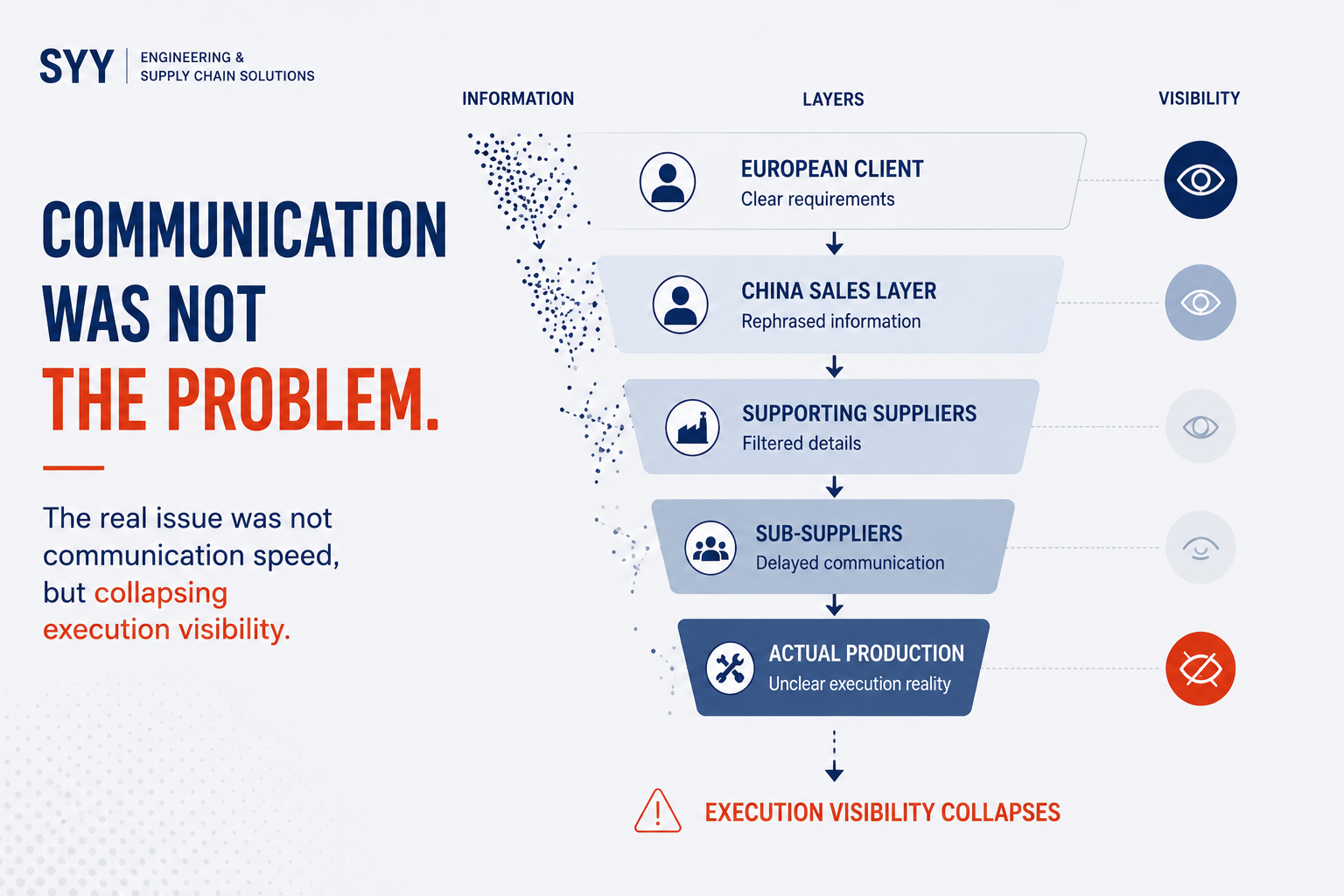
The real issue was not communication speed, but communication structure
Over time,
the client began noticing something important.
Everyone was replying.
But:
No one was actually controlling execution.
More importantly,
the internal structure behind the project kept changing.
People who had originally made commitments left the project.
New contacts entered the process.
Previously confirmed decisions began:
• being re-discussed
• being reinterpreted
• being re-evaluated
Gradually,
the project entered a very typical situation:
It continued looking active.
But execution visibility kept decreasing.
What Actually Broke Down Was The Communication Structure
The client originally believed the issue was communication.
But after on-site validation,
the real situation became visible.
The issue was not:
communication speed.
The issue was:
the communication structure could no longer support execution control.
The actual information chain had become:
European Client
→ China Sales Layer
→ Supporting Suppliers
→ Actual Production
During this process,
information became:
• filtered
• simplified
• delayed
• distorted
The more communication layers existed,
the lower the execution visibility became.
As a result,
problems continued appearing.
But nobody could clearly explain why.
Why The Supplier Kept Saying “Yes”
This is one of the most difficult realities for many European companies to understand.
The supplier never actually rejected the project.
The answers were always:
“Yes”
“No problem”
“We are checking”
“We are discussing internally”
Naturally,
the client believed the project was progressing.
But internally,
many suppliers had:
• not committed real resources
• not established real priority
• not assigned clear ownership
• not achieved engineering alignment
So from the outside,
the project appeared active.
But in reality:
execution had never truly started.
The Hidden Outsourcing Structure
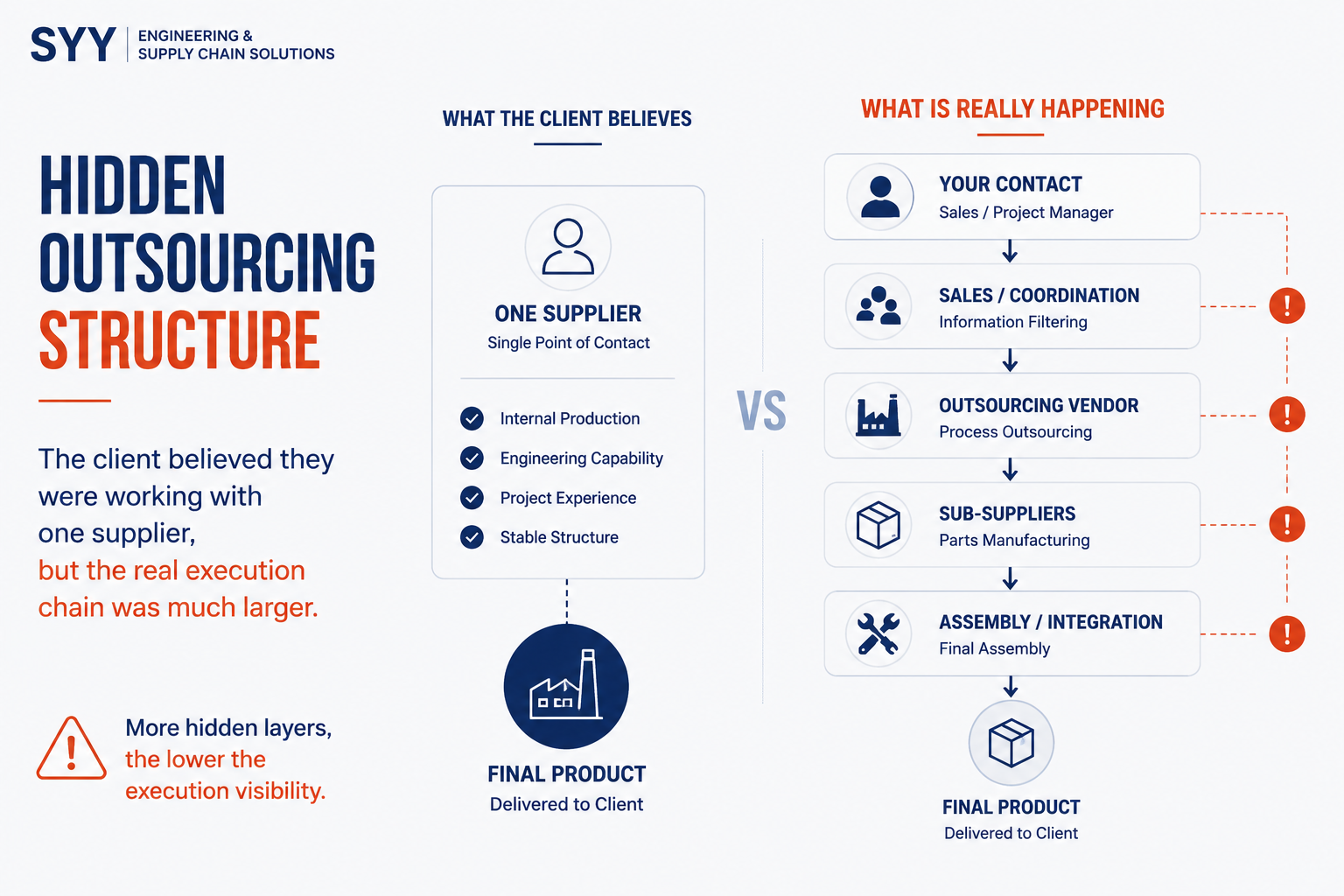
The client believed they were working with one supplier, but the execution chain was much larger
One key supplier appeared to have:
• its own factory
• its own team
• internal capability
• relevant project experience
But deeper validation revealed something different.
Critical processes depended heavily on outsourcing.
Actual production was not fully controlled internally.
As a result,
the project had effectively become:
a combination of multiple invisible execution layers.
But the client still believed:
they were working with a single supplier.
Why Reality Only Became Visible On Site
Only after entering the actual operating environment
did the real structure behind the project become visible.
Including:
• who actually made decisions
• who controlled production
• which processes were outsourced
• which suppliers were only communication layers
• which projects had no real priority
• where technical understanding was inconsistent
At this point,
the client realized something critical.
The issue was not execution difficulty.
The issue was:
the execution structure itself had already lost control.
What SYY Actually Changed Was Not Translation
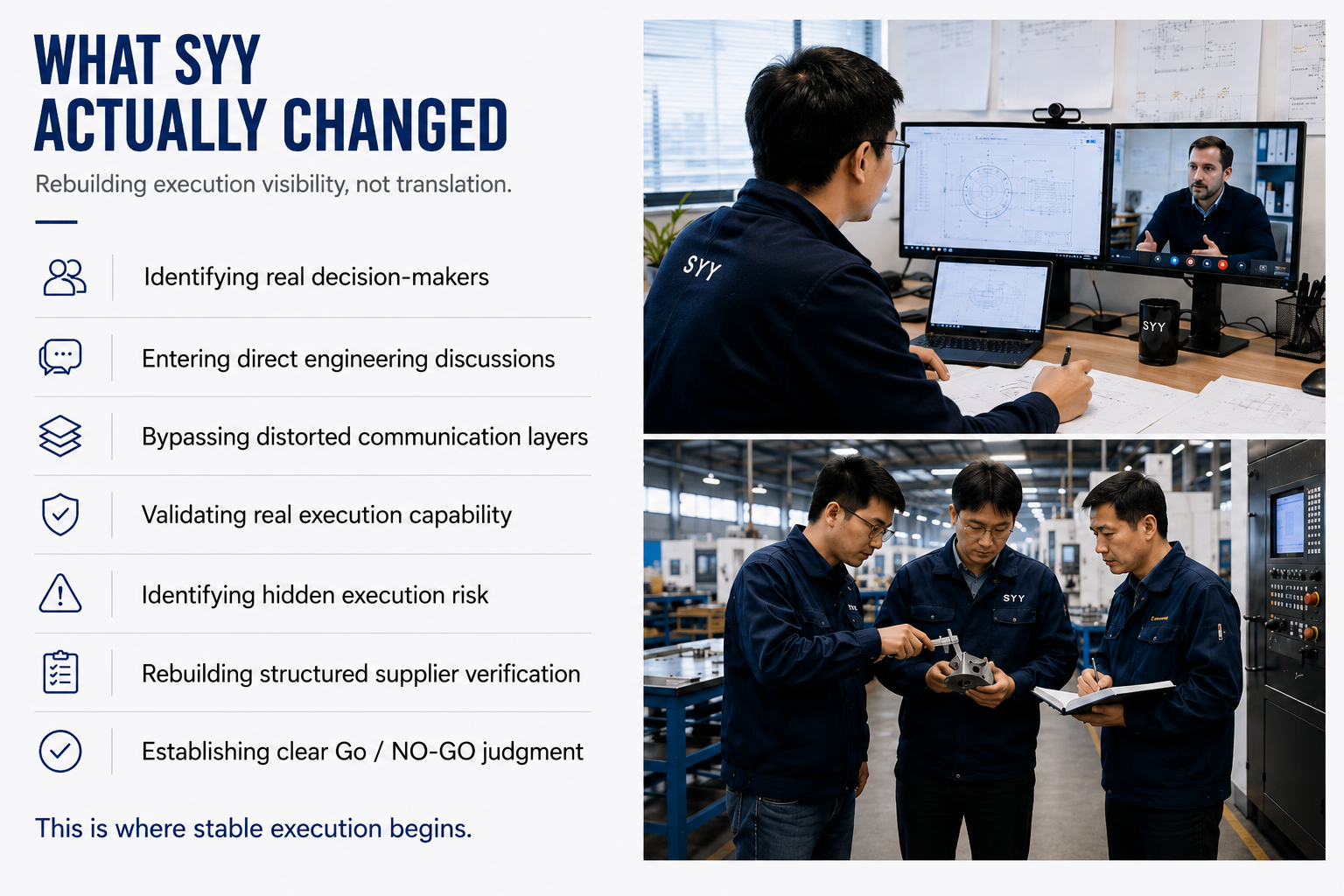
The critical issue was not translation, but execution visibility
SYY’s role was not simple communication support.
The real role was:
rebuilding execution visibility.
This included:
• identifying real decision-makers
• entering direct engineering discussions
• bypassing distorted communication layers
• validating supplier reality on site
• identifying hidden execution risk
• establishing real Go / No-Go judgment
Many Project Problems Begin Before Production Starts
Many projects do not fail during production.
They fail because:
execution structure was already unstable before production even began.
Including:
• responsibility fragmentation
• communication distortion
• hidden outsourcing
• false project movement
• lack of execution ownership
• changing decision-makers
• unstable internal alignment
Frequently Asked Questions
1. Why do projects remain active but never really progress?
Because communication activity is not the same as execution control.
2. Why do suppliers keep saying “yes” if the project is not moving?
Because “yes” often only means:
the project has not been rejected.
It does not mean real internal commitment already exists.
3. Why are these problems difficult to identify remotely?
Because many execution risks only become visible inside the real operating structure.
4. Why does outsourcing create so much complexity?
Because communication chains become longer,
while execution visibility continues decreasing.
5. Why is on-site validation more important than meetings?
Because many real problems do not exist in presentations.
They exist inside the actual execution structure.
Related Articles
Understand why
factory audits do not reduce real execution risk.
Understand how
Go / No-Go supplier decisions should be structured before supplier visits.
See
what must actually be verified during supplier visits in China.
Learn how
suppliers should be compared after factory visits.
Understand the full
supplier verification logic in China.
Talk to Our Engineers
If you are sourcing in China:
Do not rely on impressions.
Most supplier problems begin long before production starts.
SYY helps European companies:
• structure supplier decisions
• validate real execution capability
• compare suppliers using engineering logic
• reduce hidden execution risk
• turn factory visits into clear decisions
Tags
Continue Reading
Explore related insights on the same topic.
What Happens After CNC Machines Arrive in Europe: Understanding the Execution Gap
After 40 days at sea, CNC machines arrive in Europe — but execution starts here. This case reveals the often-overlooked gap between factory validation and on-site integration.
Can China’s Zero-Carbon Factory Data Support EU Buyers?
Can China’s zero-carbon factory data support an EU buyer’s import, product, procurement or local-production decision? The answer depends on evidence scope, method, responsibility and validation.
How to Compare Suppliers After a China Factory Visit
Supplier comparison after factory visits should be based on execution capability, process stability, engineering alignment, and operational risk — not impressions or price alone.