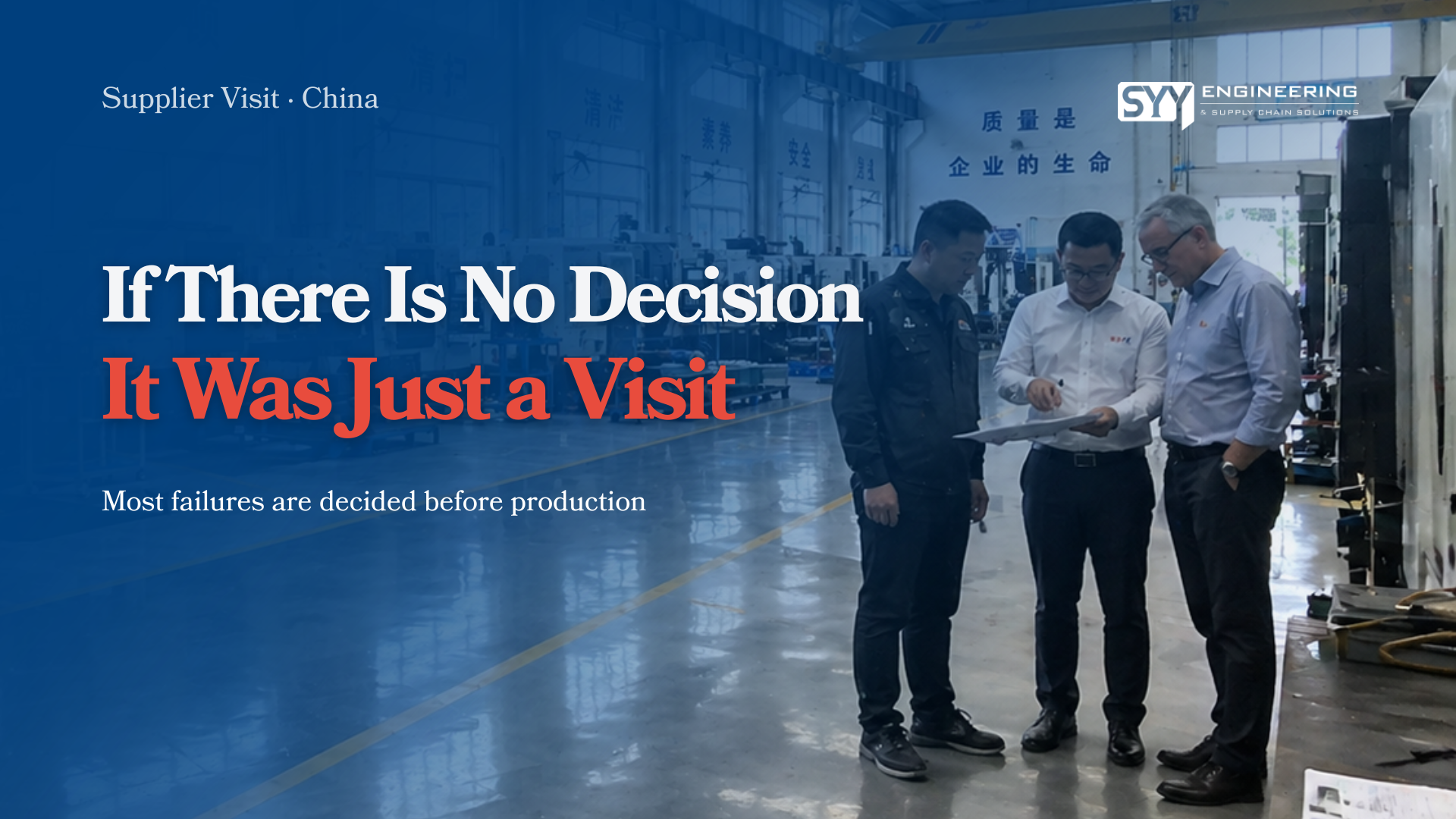
Supplier Visit & Capability Validation in China
Structured supplier visits in China with engineering validation, decision-maker access, and clear Go / No-Go outputs. Turn factory visits into real decisions.
Most Factory Visits Do Not Lead To A Decision
Most factory visits in China do not fail.
They simply do not lead to a clear decision.
Most European companies can organize a supplier trip to China.
They can:
• visit factories
• meet suppliers
• collect quotations
• compare basic information
But after returning, the same problem often remains:
The decision is still unclear.
The issue is not the travel itself.
The issue is that the visit was never structured as a validation process.
That is why many supplier trips generate more impressions, more notes, and more discussion — but not more certainty.
The Real Problem: Visits Without Validation
A factory visit without structure usually leads to:
• too many suppliers
• conflicting opinions
• no clear comparison
• hidden risks not identified
This is exactly why many supplier decisions fail before production even begins.
And most of these failures are not visible during the visit.
This is why many supplier decisions fail before production even begins.
A “Yes” Does Not Mean The Project Is Accepted
A supplier saying “yes” during a visit does not mean the project is truly accepted.
And this is where many European teams are misled.
In many cases, it only means:
• the supplier is open to quoting
• the project is not rejected early
• or it may be considered later
What is often missing is:
• real resource commitment
• engineering prioritization
• execution readiness
This is why many projects appear to move —
but do not actually progress.
Why Factory Audits Are Not Enough
Many companies rely on audits to reduce uncertainty.
But audits:
• capture a moment
• do not validate execution
• do not ensure alignment
• do not reveal real operating risk
A factory audit is not a decision tool.
A supplier can pass an audit and still fail later because:
• the engineering understanding was incomplete
• the project was not prioritized
• the process looked acceptable but was not stable
• real decision-makers were never involved
What SYY Does Differently
SYY transforms supplier visits into a structured engineering process.
Not more visits.
Better decisions.
This is the difference between:
• visiting factories
• validating suppliers
The Visit Is A Decision System
SYY treats each visit as a system that must answer:
• can this supplier support the project
• is the capability proven
• is the process stable
• is the technical understanding aligned
• are the real risks visible
Our Approach: From Visit To Decision
1. Define What Must Be Verified Before The Trip
Before the visit, SYY helps clarify:
• technical requirements
• project priorities
• critical risks
• supplier fit
• Go / Conditional / No-Go criteria
The visit starts with structure.
Not exploration.
2. Structure The Visit Around Engineering Validation
During the visit, we verify:
• real capability
• process stability
• engineering alignment
• execution risk
• decision-maker access
During the visit, we verify the elements that actually determine execution.
We focus on what matters most:
• can the supplier repeat the result
• do they really understand the specification
• is anything hidden behind the sales layer
• is outsourcing controlled or invisible
• does the factory have real execution ownership
3. Ensure Direct Access To Decision-Makers
SYY ensures direct access to:
• owners
• technical leaders
• project managers
• operations decision-makers
Because real risks appear in:
• resource allocation
• process constraints
• technical trade-offs
• delivery priorities
4. Daily Review And Structured Comparison
Each day includes:
• visit summary
• risk identification
• supplier scoring
• comparison notes
• decision direction
Decisions start during the trip, not after it.
5. Clear Go / No-Go Output
Each supplier is classified as:
• GO
• CONDITIONAL
• NO-GO
Each supplier must end with a clear result:
• GO
• CONDITIONAL
• NO-GO
No ambiguity.
No “maybe”.
What You Get
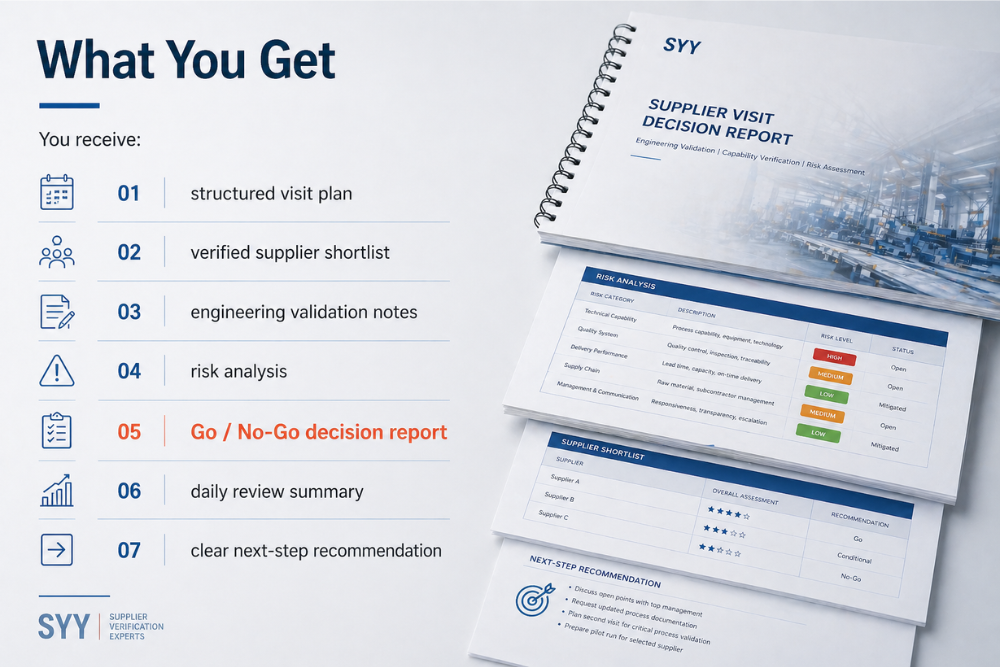
The output of a supplier visit should be a decision system, not only a report
You receive:
• structured visit plan
• verified supplier shortlist
• engineering validation notes
• risk analysis
• Go / No-Go decision report
• daily review summary
• clear next-step recommendation
This is not documentation.
It is a decision system.
Typical Scenario
Before SYY:
• all suppliers appear possible
• no clear comparison exists
• decisions become delayed
• risks remain hidden
With SYY:
• weak suppliers are eliminated early
• risks are identified on-site
• decision-makers are reached directly
• a clear shortlist is built within days
Faster decision. Lower risk. Better control.
What Happens If This Is Not Structured
Without structured validation:
• suppliers appear capable but are not
• risks remain hidden until production
• projects slow down without clear reason
• decisions become delayed or reversed
And by the time the problem becomes visible,
the cost is already high.
Why This Matters For European Companies
For European companies:
• time is limited
• travel budgets are limited
• engineering resources are limited
Every visit must produce:
• real validation
• visible risk
• structured comparison
• decision-ready output
Final Reinforcement
A factory visit is not about seeing a supplier.
It is about deciding whether the project can support stable execution.
If a visit is based on:
• presentations
• impressions
• general discussions
the result will remain unclear.
Before your next China visit, define the decision — not just the schedule.
Talk to Our Engineers
If you are sourcing in China:
Do not rely on impressions.
Most supplier problems begin long before production starts.
SYY helps European companies:
• structure supplier decisions
• validate real execution capability
• compare suppliers with engineering logic
• reduce hidden execution risk
• turn factory visits into clear decisions
Tags
Continue Reading
Explore related insights on the same topic.
What to Verify During a China Factory Visit
Most factory visits in China focus on observation rather than validation. Learn what must be verified on site to evaluate execution capability and production stability.
Supplier Verification in China: Why Most Supplier Decisions Fail — and What Verification Actually Means
Most supplier decisions in China fail before production begins. Learn how engineering-led supplier verification ensures the right decision, reduces risk, and delivers reliable execution.
How to Compare Suppliers After a China Factory Visit
Supplier comparison after factory visits should be based on execution capability, process stability, engineering alignment, and operational risk — not impressions or price alone.