Go / No-Go Supplier Decision Before Visiting China
Most supplier decisions fail before factory visits begin. Define Go / No-Go criteria in advance to reduce execution risk and improve supplier selection in China.
Most supplier decisions are determined before the visit begins.
Not by what is seen in China —
but by what is defined in advance.
Most Teams Prepare The Trip — Not The Decision
Before going to China, most teams prepare:
• supplier lists
• travel schedules
• meeting agendas
Everything appears organized.
But one critical element is often missing:
What defines an acceptable supplier — and what defines a supplier that must be rejected?
Without a defined decision structure, every supplier starts to look “possible.”
This is where supplier selection begins to lose control.
The Core Problem: Decisions Without Criteria
The problem is not the factory.
The problem is the decision logic brought into the visit.
Without a unified framework:
• departments evaluate suppliers differently
• technical discussions remain superficial
• risks are identified too late
• suppliers are compared based on perception
The result is simple:
Comparison without conclusion.
The Right Question
Supplier decisions should start with one question:
Under what conditions must a supplier be rejected?
Because:
If NO-GO is unclear,
GO has no meaning.
Most companies try to prove that a supplier is acceptable.
Very few define:
• rejection criteria
• unacceptable risk
• mandatory requirements
This is where decision quality begins.
The SYY Go / No-Go Decision Framework
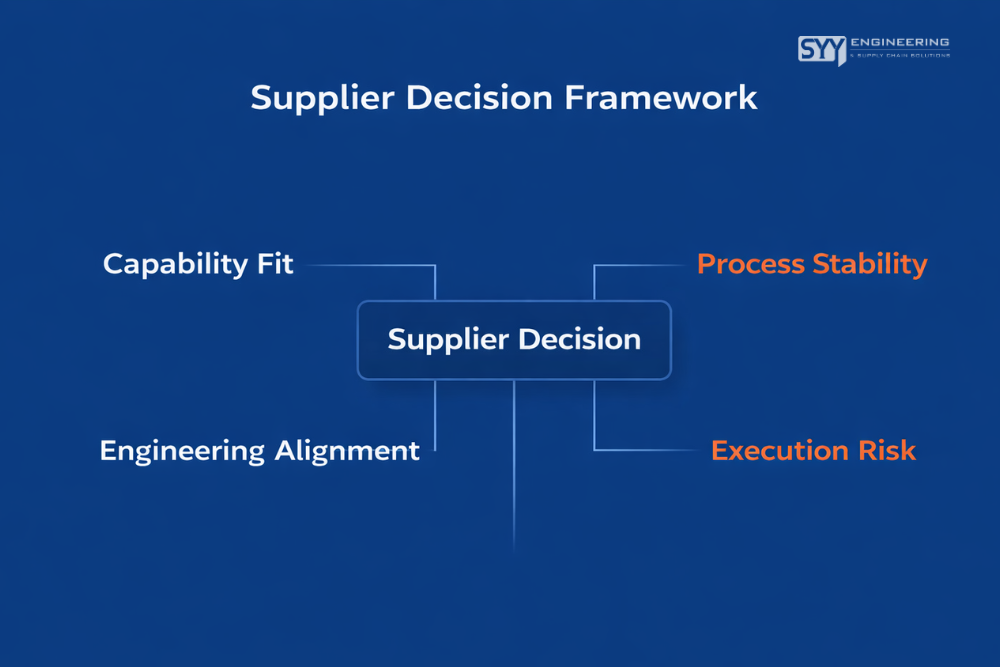
Supplier decisions must be based on capability fit, process stability, engineering alignment, and execution risk
SYY structures supplier decisions around four engineering judgment layers.
This is not a checklist.
It is a decision system.
Supplier decisions must be based on:
• capability fit
• process stability
• engineering alignment
• execution risk
1. Capability Fit
Can this supplier actually support the project —
not in theory, but in real operating conditions?
Define in advance:
• required manufacturing capability
• critical equipment and processes
• comparable project experience
• in-house vs outsourced operations
Decision Rule
No verified capability = NO-GO
2. Process Stability
Can the supplier reproduce results consistently?
Define in advance:
• required level of process control
• standardization of production steps
• traceability and inspection logic
• dependence on systems vs individuals
Decision Rule
Unstable process = CONDITIONAL or NO-GO
3. Engineering Alignment
Are both sides working from the same technical understanding?
Define in advance:
• drawing interpretation
• critical tolerances
• material requirements
• interface and assembly logic
Decision Rule
Misalignment = NO-GO
4. Execution Risk
Will the project remain under control after supplier selection?
Define in advance:
• acceptable level of outsourcing
• change control requirements
• responsibility ownership
• delivery reliability
Decision Rule
Uncontrollable risk = NO-GO
Manageable risk = CONDITIONAL
Final Output: Decision, Not Discussion
Each supplier must end with a clear result:
• GO
• CONDITIONAL
• NO-GO
This is not discussion.
It is decision output.
What This Framework Changes
Without a Go / No-Go framework:
• visits become tours
• meetings become information exchange
• comparison becomes confusion
• decisions become repeated delay
With a framework:
• visits become structured validation
• questions become decision criteria
• comparison becomes structured
• output becomes actionable
The trip changes completely.
It is no longer about seeing more.
It is about rejecting earlier and deciding faster.
A Reality Most Companies Realize Too Late
Most supplier problems do not begin during production.
They begin when the wrong supplier is selected.
The real cost is not only:
• delay
• quality instability
• rework
The real cost is:
A supplier decision made without defined criteria.
Frequently Asked Questions
1. How many factories should we visit?
Quantity does not improve decision quality.
Without a decision framework, more visits often create more confusion.
What matters is whether each visit is used for structured validation during the evaluation process.
2. Can supplier decisions be made without an engineering team?
The risk is high.
Supplier evaluation is not only commercial.
It requires engineering judgment.
Otherwise:
• drawings may be misunderstood
• process risks remain hidden
• execution gaps appear too late
3. What does CONDITIONAL actually mean?
It means progression under defined requirements.
You must define:
• what the conditions are
• when they must be completed
• what happens if they are not achieved
Otherwise:
CONDITIONAL becomes delayed decision-making.
4. Is a factory audit enough?
No.
A factory audit only evaluates visible conditions at a specific moment.
It cannot replace:
• engineering validation
• process judgment
• execution risk assessment
This is where deeper supplier verification becomes necessary.
5. When should Go / No-Go be defined?
Before the visit.
If defined afterward:
• impressions already influence judgment
• comparison becomes subjective
• risks become harder to eliminate
How SYY Supports This Process
SYY does not help companies visit more factories.
SYY helps companies define supplier decisions before visits become expensive confusion.
We help clients:
• define supplier decision criteria before travel
• structure validation around those criteria
• compare suppliers using one shared framework
• deliver clear Go / No-Go conclusions
Final Reinforcement
Most companies prepare the schedule.
Very few define the decision.
That is why:
• visits create activity
• discussions create information
• but supplier decisions still do not happen
A supplier is not selected because it appears acceptable.
It is selected because unacceptable risk has already been rejected.
Talk to Our Engineers
If you are sourcing in China:
Do not rely on impressions.
Most supplier problems begin long before production starts.
SYY helps European companies:
• structure supplier decisions
• validate real execution capability
• compare suppliers with engineering logic
• reduce hidden execution risk
• turn factory visits into clear decisions
Tags
Continue Reading
Explore related insights on the same topic.
How to Compare Suppliers After a China Factory Visit
Supplier comparison after factory visits should be based on execution capability, process stability, engineering alignment, and operational risk — not impressions or price alone.
Supplier Visit & Capability Validation in China
Structured supplier visits in China with engineering validation, decision-maker access, and clear Go / No-Go outputs. Turn factory visits into real decisions.
What to Verify During a China Factory Visit
Most factory visits in China focus on observation rather than validation. Learn what must be verified on site to evaluate execution capability and production stability.