What to Verify During a China Factory Visit
Most factory visits in China focus on observation rather than validation. Learn what must be verified on site to evaluate execution capability and production stability.
You are standing inside the factory.
But you still do not know whether the supplier can support stable execution.
Most factory visits appear productive.
You meet the team.
You walk through the workshop.
You see machines running.
But when the visit ends, the critical question often remains unanswered.
Because what was observed was activity — not validation.
A Factory Visit Without Verification Is Just Observation
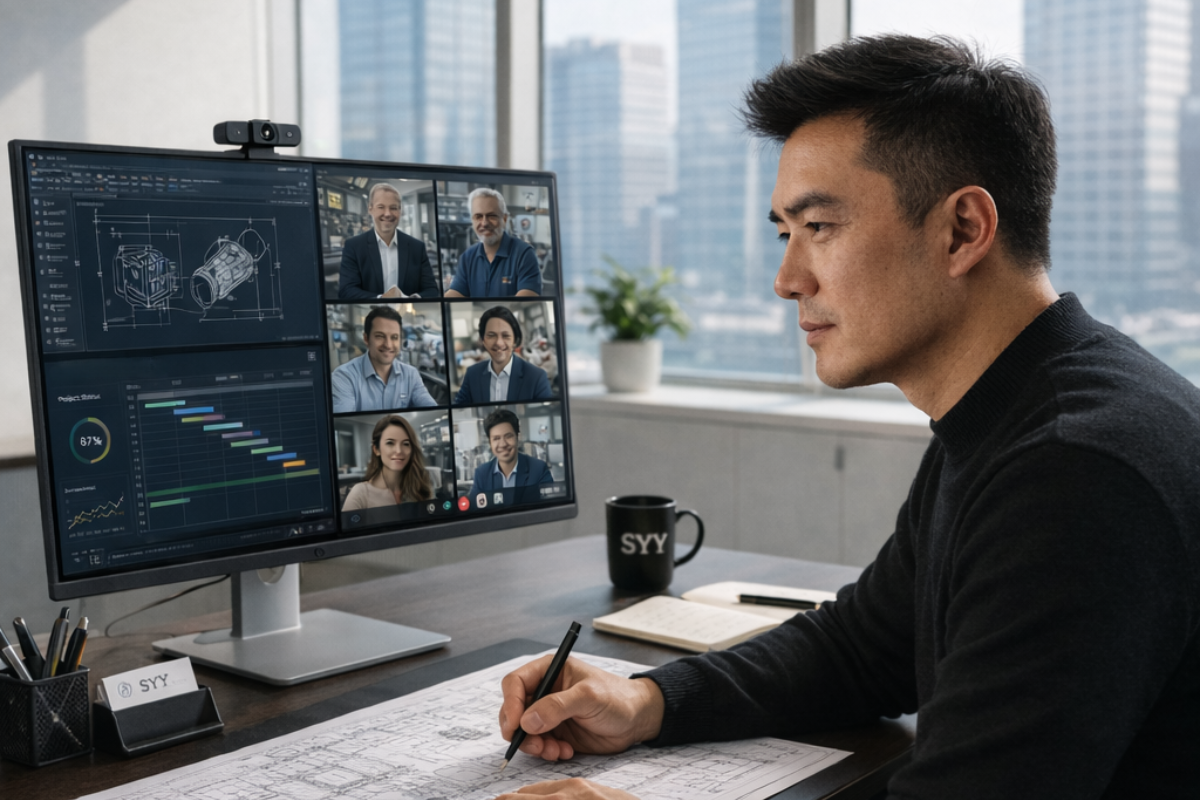
A supplier visit should begin with verification criteria, not only with a meeting schedule
Observation Is Not Validation
Many European companies travel to China with the right intention.
They want to understand the supplier, assess the factory, and move forward with confidence.
But most visits are not structured for validation.
They are structured around:
• presentation
• hospitality
• general discussion
• factory tours
Instead of:
• capability validation
• process verification
• engineering alignment
• access to real decision-makers
• execution risk evaluation
A visit that is not structured for validation cannot support a reliable conclusion.
What Most Visits Still Miss
A supplier rarely “fails” during the visit.
The real problems appear later — when assumptions meet execution.
Typical risks are not visible during a standard visit:
• hidden outsourcing
• unstable or inconsistent processes
• no access to real decision-makers
• misalignment between sales claims and production reality
Everything may appear acceptable on the surface.
But what is not validated during the visit often becomes the source of execution risk later.
If You Don’t Verify, You Are Guessing
If a visit does not verify the right elements, the project moves forward on assumptions:
“They probably understand the drawing.”
“They seem experienced.”
“They confirmed delivery timing would not be an issue.”
These assumptions may sound reasonable during the visit.
But they are not evidence.
And decisions made without evidence are not real decisions.
This is why many supplier decisions fail before production begins.
This is why supplier problems often appear:
• during quotation clarification
• during sample approval
• during trial production
• during delivery pressure
By then, changing direction is already expensive.
What Must Be Verified On Site
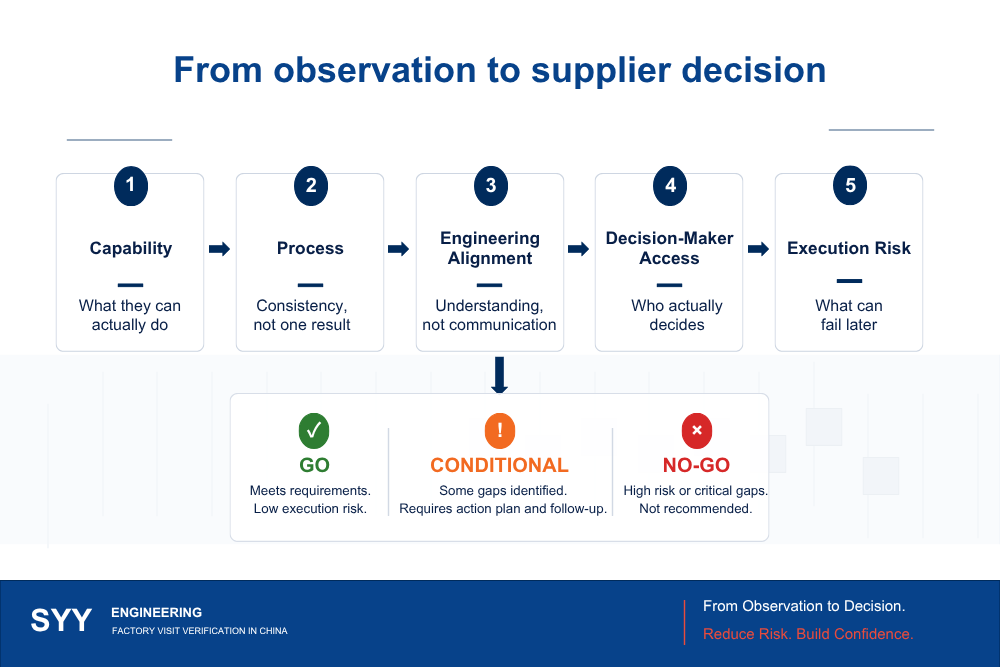
Supplier visits should verify capability, process, alignment, decision-maker access, and execution risk
A China factory visit should not be open-ended.
It should support a structured validation process.
The visit should follow pre-defined Go / No-Go criteria before the trip even begins.
1. Capability
A supplier should not be evaluated by what is said during the visit.
It should be evaluated by what has already been executed successfully.
Verify:
• comparable projects or products
• actual use of key machines and processes
• in-house vs outsourced operations
• consistency between claims and real workflow
A factory that appears capable is not always a supplier that can support stable execution.
2. Process
A successful sample does not prove production control.
Many suppliers can produce a good sample under temporary attention.
The real question is whether results can be repeated consistently.
Verify:
• process flow
• control points
• inspection logic
• traceability
• stability across batches and operators
If the process is unstable, the result will not be repeatable.
3. Engineering Alignment
This is where many projects fail quietly.
Even when communication appears smooth.
Verify:
• drawing interpretation
• tolerance understanding
• material confirmation
• assembly logic
• real technical response
Good communication does not guarantee correct technical understanding.
4. Decision-Maker Access
Many factory visits are filtered through sales teams or intermediaries.
That limits what can actually be verified.
Verify:
• who makes technical decisions
• who approves changes
• who controls production priority
• who takes responsibility when problems occur
Without access to decision-makers, the visit only reveals part of the operational reality.
5. Execution Risk
A supplier may appear strong during the visit and still fail later during production.
Because execution pressure reveals what the visit does not.
Verify:
• hidden outsourcing
• weak change control
• delayed problem escalation
• promises without supporting evidence
What is not validated during the visit often becomes visible during execution — at a cost.
From Visit To Decision
A visit only creates value when it leads to a clear conclusion.
• capability
• process
• engineering alignment
• decision-maker access
• execution risk
↓
• GO
• CONDITIONAL
• NO-GO
If a visit does not produce a clear outcome, it has not reduced risk.
Common Visit Mistakes That Weaken Decisions
Most companies repeat the same mistakes:
• relying on presentation instead of validation
• skipping technical verification
• confusing communication with engineering alignment
• ignoring outsourcing risk
• leaving without structured review
A well-organized visit can still produce a weak conclusion.
The Real Cost Of A Bad Visit
A factory visit does not fail because the factory was bad.
It fails because the decision made after the visit was weak.
The real cost is not the travel itself.
It is:
• time lost
• wrong supplier selection
• rework
• delays
• execution instability
Most costs appear when problems are discovered too late — when correction becomes expensive.
FAQ
1. What is a factory visit supposed to achieve?
A factory visit should support a structured supplier decision — not just create impressions.
2. Why do factory visits often fail?
Because they focus on what is visible instead of what must be validated.
3. Can a factory visit replace full supplier verification?
No.
It is only one part of a structured supplier verification process.
4. What should happen after the visit?
Each supplier should be clearly classified:
• GO
• CONDITIONAL
• NO-GO
Final Reinforcement
A factory visit is not about seeing a supplier.
It is about deciding whether execution can be trusted.
Talk to Our Engineers
If you are sourcing in China:
Do not rely on impressions.
Most supplier problems begin long before production starts.
SYY helps European companies:
• structure supplier decisions
• validate real execution capability
• compare suppliers with engineering logic
• reduce hidden execution risk
• turn factory visits into clear decisions
Tags
Continue Reading
Explore related insights on the same topic.
How to Compare Suppliers After a China Factory Visit
Supplier comparison after factory visits should be based on execution capability, process stability, engineering alignment, and operational risk — not impressions or price alone.
Supplier Visit & Capability Validation in China
Structured supplier visits in China with engineering validation, decision-maker access, and clear Go / No-Go outputs. Turn factory visits into real decisions.
Supplier Verification in China: Why Most Supplier Decisions Fail — and What Verification Actually Means
Most supplier decisions in China fail before production begins. Learn how engineering-led supplier verification ensures the right decision, reduces risk, and delivers reliable execution.