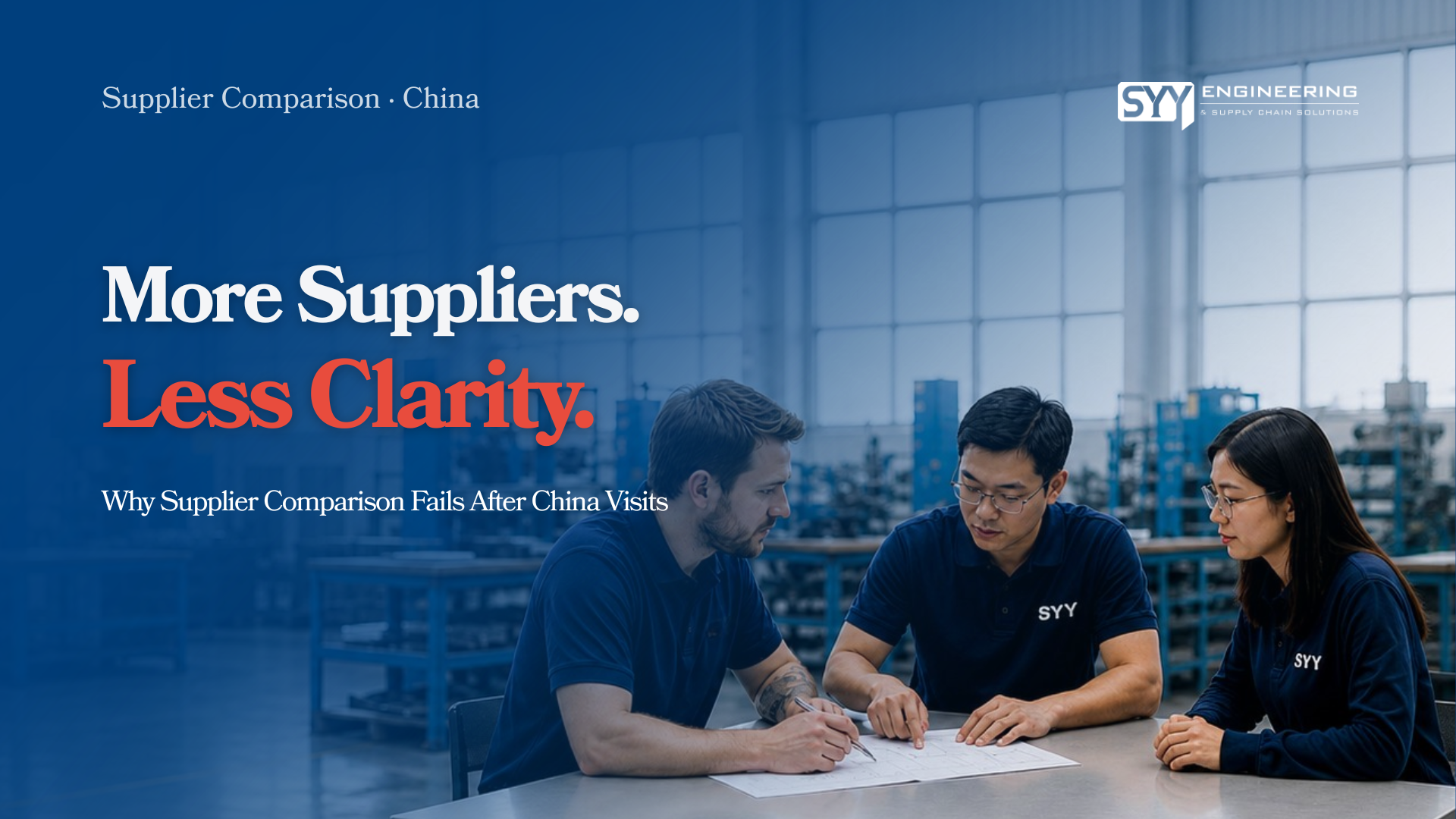
How to Compare Suppliers After a China Factory Visit
Supplier comparison after factory visits should be based on execution capability, process stability, engineering alignment, and operational risk — not impressions or price alone.
More Factory Visits Do Not Create Better Decisions
You visited multiple factories.
Yet you still cannot decide.
That is not a supplier problem.
It is a comparison problem.
Most European companies return from China with:
• multiple “possible” suppliers
• different technical impressions
• internal disagreement
• no clear decision
More factories did not create clarity.
They created more options — without a decision.
Many teams only realize this after returning from China:
Supplier decisions become harder after factory visits.
Verification determines whether a supplier is viable.
Comparison determines which supplier should move forward.
Before comparison can happen, supplier capability must first be validated correctly.
The Real Problem: Comparison Happens Too Late
Most teams compare suppliers after returning home.
At that point, the decision process is already weakened.
Because:
• facts are no longer precise
• signals are no longer visible
• discussions replace observations
Comparison without structure becomes opinion.
Why Supplier Comparison Fails
Most comparisons are based on:
• presentation quality
• communication comfort
• price
• isolated impressions
None of these determine execution capability.
Real comparison must be based on:
• capability fit
• process stability
• engineering alignment
• execution risk
• decision control
If you are not comparing execution capability,
you are not making a real supplier decision.
If Go / No-Go logic is not defined before the visit, comparison will always become subjective later.
What Must Be Compared (Decision Logic)
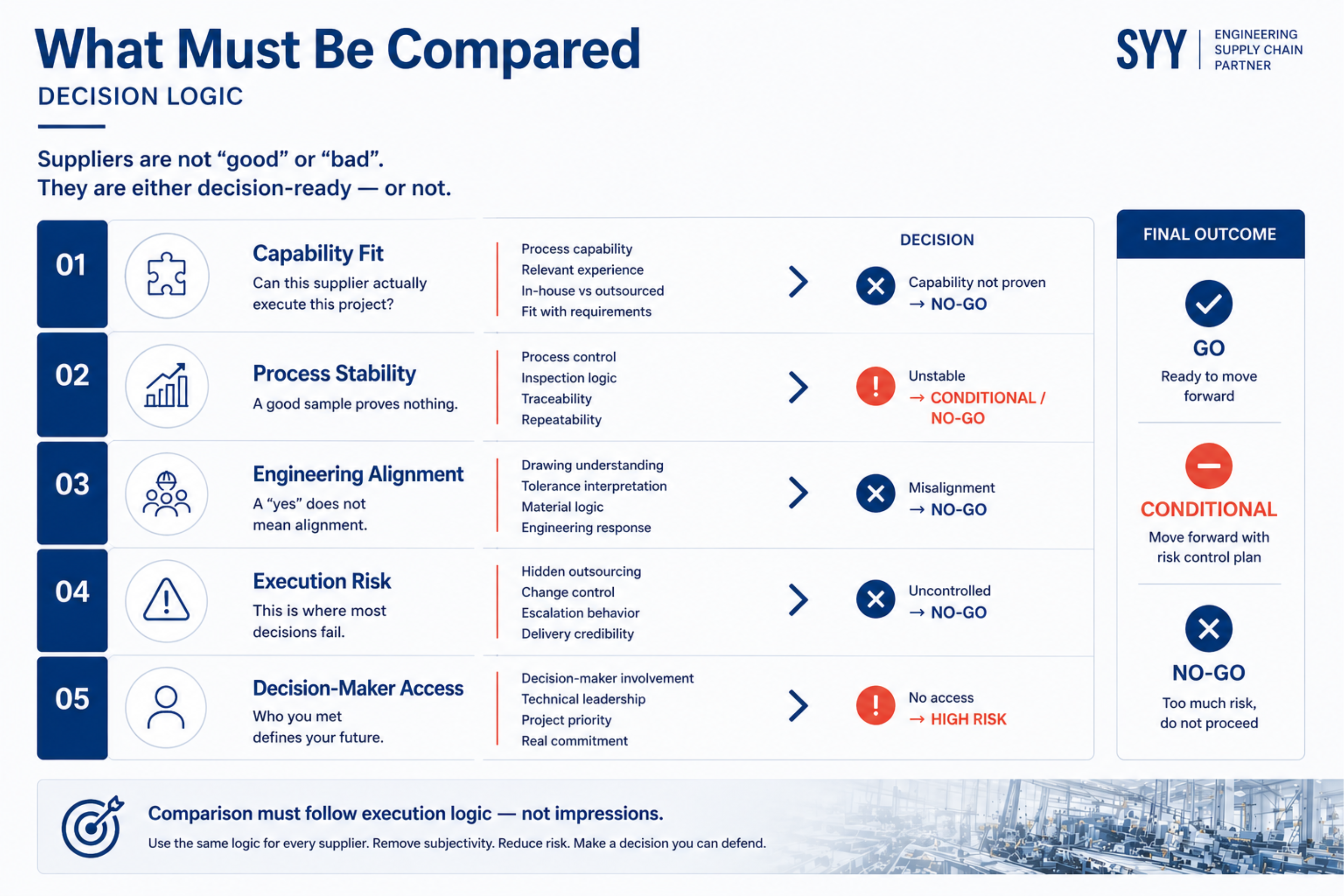
Supplier comparison must follow execution logic, not impressions
Suppliers are not simply “good” or “bad”.
They are either decision-ready — or not.
1. Capability Fit
Can this supplier actually execute the project?
Compare:
• real process capability
• relevant experience
• in-house vs outsourced operations
• fit with technical requirements
A capable factory is not always the right factory.
Decision:
Capability not proven → NO-GO
2. Process Stability
A good sample proves nothing.
Compare:
• process control
• inspection logic
• traceability
• repeatability
Most failures begin with instability — not visible defects.
Decision:
Unstable → CONDITIONAL / NO-GO
3. Engineering Alignment
A “yes” does not mean alignment.
Compare:
• drawing understanding
• tolerance interpretation
• material logic
• engineering response
A “yes” without shared understanding creates execution risk.
Decision:
Misalignment → NO-GO
4. Execution Risk
This is where many supplier decisions fail.
Compare:
• hidden outsourcing
• change control
• escalation behavior
• delivery credibility
Execution risk is often invisible during the visit —
but unavoidable during production.
Decision:
Uncontrolled → NO-GO
5. Decision-Maker Access
Who you meet defines what you can actually verify.
Compare:
• decision-maker involvement
• technical leadership presence
• project priority
• real commitment
If decision-makers are not involved,
the operational reality is still unclear.
Decision:
No access → high execution risk
From Comparison To Decision
Comparison is not about finding the “best” supplier.
It is about eliminating the wrong ones — early.
Every supplier must end with:
• GO
• CONDITIONAL
• NO-GO
If there is no clear result,
there is no real comparison.
If Go / No-Go logic is not defined before the visit, comparison will always become subjective later.
Common Mistakes After a China Trip
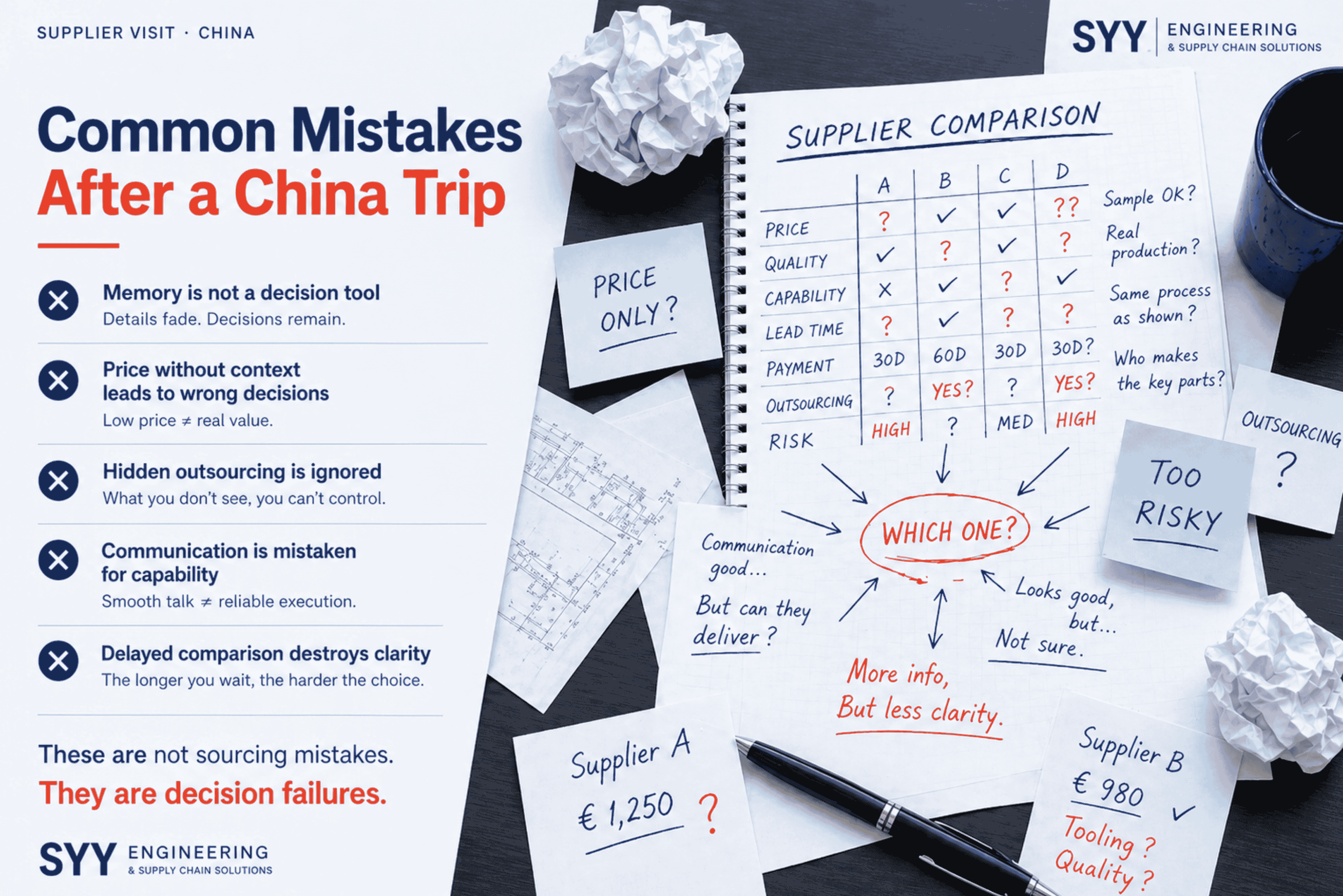
Most supplier comparison mistakes happen after returning, not during visits
• memory is not a decision tool
• price without context leads to weak decisions
• hidden outsourcing is ignored
• communication is mistaken for capability
• delayed comparison destroys clarity
These are not sourcing mistakes.
They are decision failures.
Many of these failures begin because supplier comparison was never structured during the visit itself.
What Companies Actually Need
Most companies do not lack suppliers.
They lack decision clarity.
They need:
• fewer options
• clearer comparison
• faster decisions
• internal alignment
• confidence before commitment
More data does not solve this.
Structure does.
A Reality Most Teams Realize Too Late
The wrong supplier is rarely selected because of a bad visit.
It is selected because of weak comparison.
And the cost appears later:
• quotation
• sampling
• production
• delivery
The decision was already wrong —
before execution began.
Frequently Asked Questions
1. Is price the main comparison factor?
No.
Execution capability determines success — not price.
2. Can we use a simple comparison table?
Only if it reflects execution logic.
3. What if multiple suppliers seem acceptable?
Compare:
• risk
• repeatability
• execution control
4. When should the shortlist be finalized?
Immediately after the visit.
5. Why is daily review critical?
Because memory cannot support structured decisions.
How SYY Supports This Stage
SYY does not help you visit more factories.
We help you decide between them.
We help you:
• define comparison structure
• validate during visits
• identify real differences
• reduce suppliers into a shortlist
• convert comparison into decisions
Final Insight
A China trip does not create value because many factories were visited.
It creates value when one supplier decision can be defended clearly.
• why one supplier moves forward
• why the others do not
That is the difference between visiting — and deciding.
Talk to Our Engineers
If you are sourcing in China:
Do not rely on impressions.
Most supplier problems begin long before production starts.
SYY helps European companies:
• structure supplier decisions
• validate real execution capability
• compare suppliers with engineering logic
• reduce hidden execution risk
• turn factory visits into clear decisions
Tags
Continue Reading
Explore related insights on the same topic.
What to Verify During a China Factory Visit
Most factory visits in China focus on observation rather than validation. Learn what must be verified on site to evaluate execution capability and production stability.
Go / No-Go Supplier Decision Before Visiting China
Most supplier decisions fail before factory visits begin. Define Go / No-Go criteria in advance to reduce execution risk and improve supplier selection in China.
Supplier Verification in China: Why Most Supplier Decisions Fail — and What Verification Actually Means
Most supplier decisions in China fail before production begins. Learn how engineering-led supplier verification ensures the right decision, reduces risk, and delivers reliable execution.