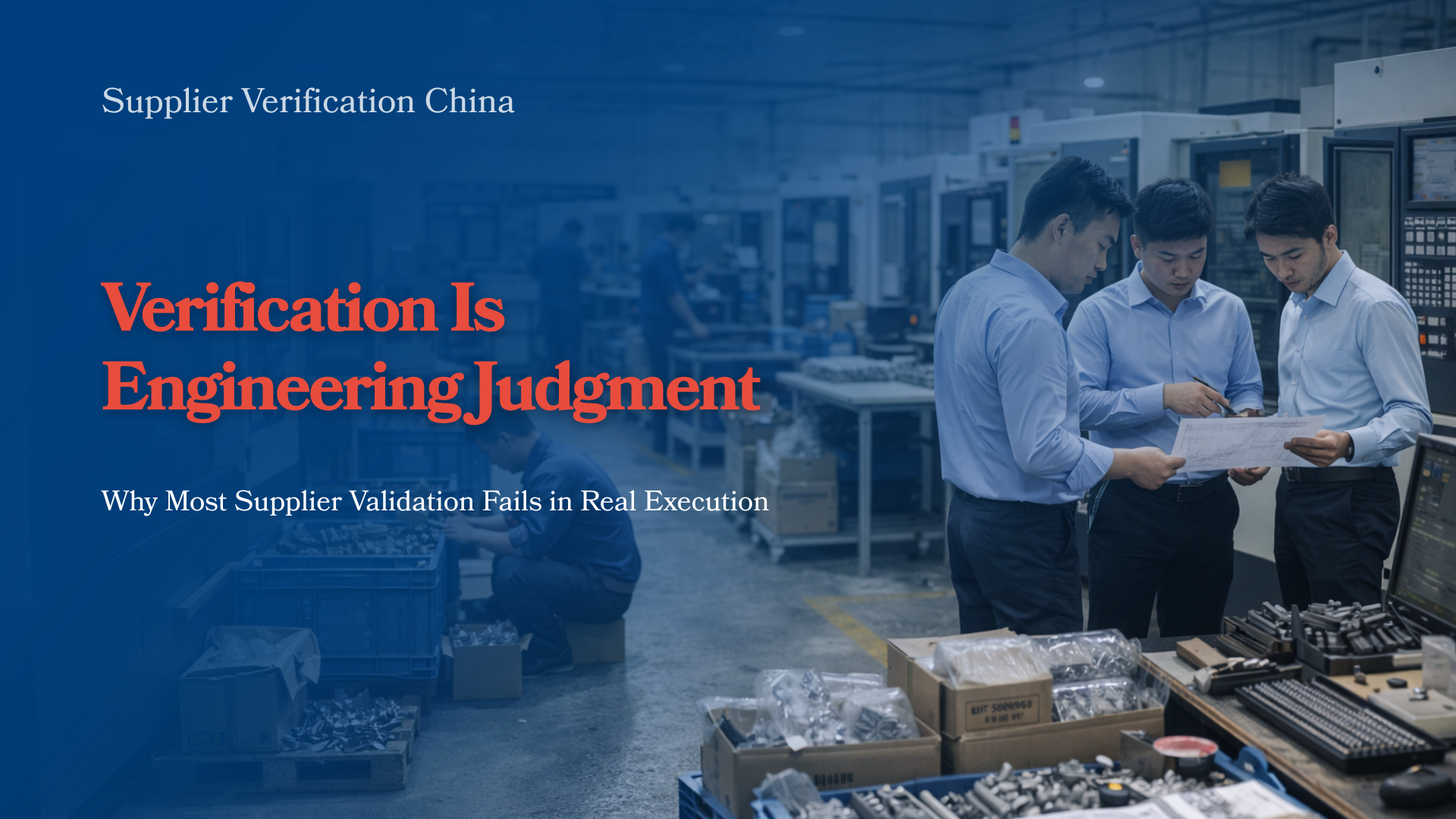
Supplier Verification in China: Why Most Supplier Decisions Fail — and What Verification Actually Means
Most supplier decisions in China fail before production begins. Learn how engineering-led supplier verification ensures the right decision, reduces risk, and delivers reliable execution.
Supplier Verification in China
What Supplier Verification Actually Means
Most EU buyers sourcing in China believe their problems start in production.
They don’t.
They start much earlier.
At the moment the supplier is selected.
Factories look convincing.
Meetings go smoothly.
Suppliers say “no problem.”
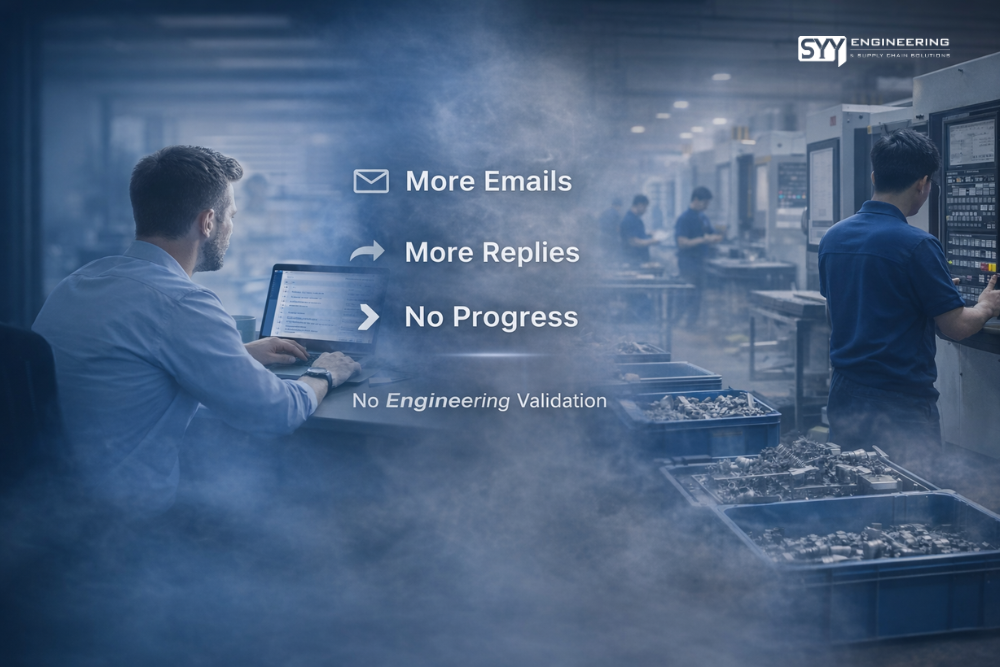
More emails and replies do not create progress — without engineering validation, communication becomes a loop
But later:
• delays begin to accumulate
• process stability becomes inconsistent
• execution control is lost
This is a decision problem.
The supplier was never truly verified.
A supplier is not risky because it fails.
A supplier is risky because it was never properly verified.
That is why supplier verification must happen before production begins.
What Supplier Verification Actually Means
Supplier verification is not a sourcing step.
It is the validation of execution capability.
Supplier verification is not:
• visiting factories
• checking certificates
• reviewing presentations
It is:
• validating real capability
• confirming engineering alignment
• identifying execution risk
The real question is not:
“Is this a good factory?”
The real question is:
“Can this supplier execute this specific project under real operating conditions?”
The SYY Verification Framework
SYY structures supplier verification around four execution layers.
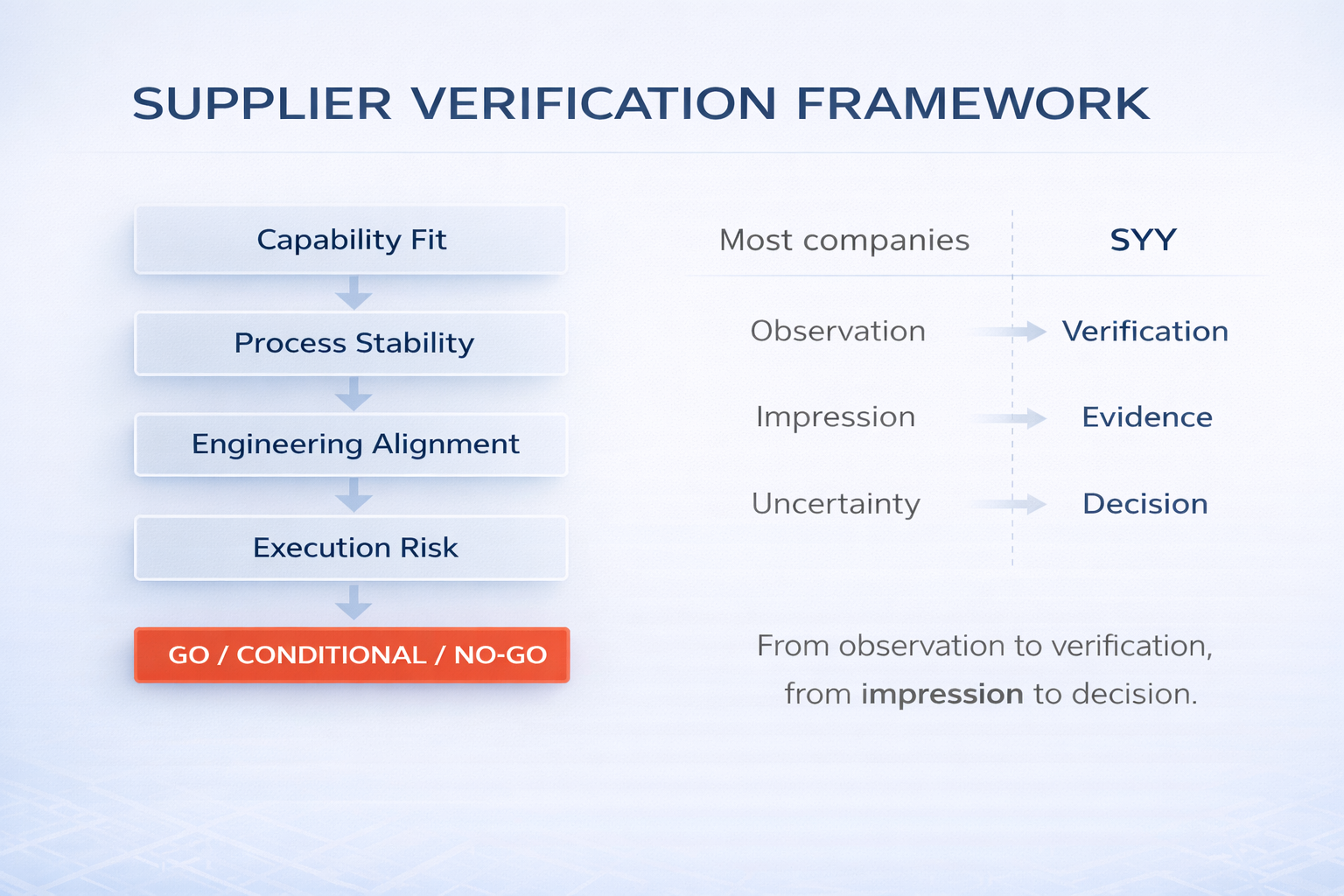
Without structured verification, supplier decisions are based on impressions — not engineering evidence
1. Capability Fit
Does the supplier actually have the capability required?
• comparable project experience
• real use of equipment
• in-house vs outsourced processes
• match with technical requirements
No proven capability = NO-GO
2. Process Stability
Can the supplier repeat results consistently?
• process control logic
• inspection systems
• traceability
• consistency across batches
A good sample is not proof.
Repeatability is.
3. Engineering Alignment
Are both sides working with the same technical understanding?
• drawing interpretation
• tolerance clarity
• material consistency
• interface logic
Misalignment = hidden risk
Execution depends on what is verified — not what is presented.
4. Execution Risk
Will the project remain under control during production?
• hidden outsourcing
• change control
• delivery reliability
• responsibility structure
A supplier may appear capable — while execution remains unstable.
Final Output
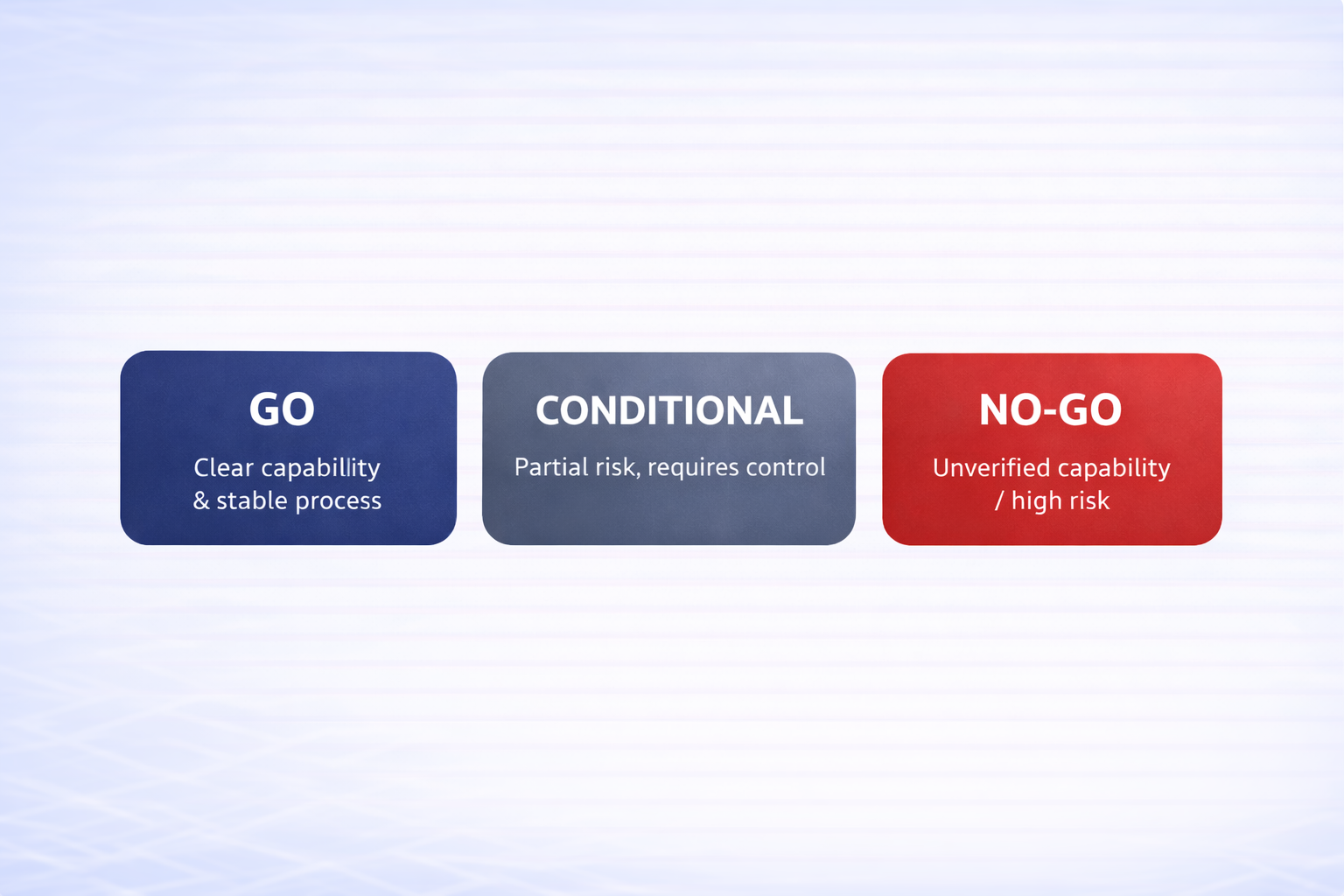
Supplier verification leads to one outcome: a clear decision — GO, CONDITIONAL, or NO-GO.
Final Output
Supplier verification must produce a defined outcome.
Every supplier is classified as:
• GO
• CONDITIONAL
• NO-GO
The objective is not more discussion.
The objective is controlled supplier selection.
Supplier Verification Checklist
A proper supplier verification should confirm:
• capability fit with the project
• process consistency under operating conditions
• measurement and tolerance control
• engineering alignment
• visibility of real execution responsibility
If these elements cannot be confirmed,
the supplier should not move forward.
Why Factory Audits Are Not Enough
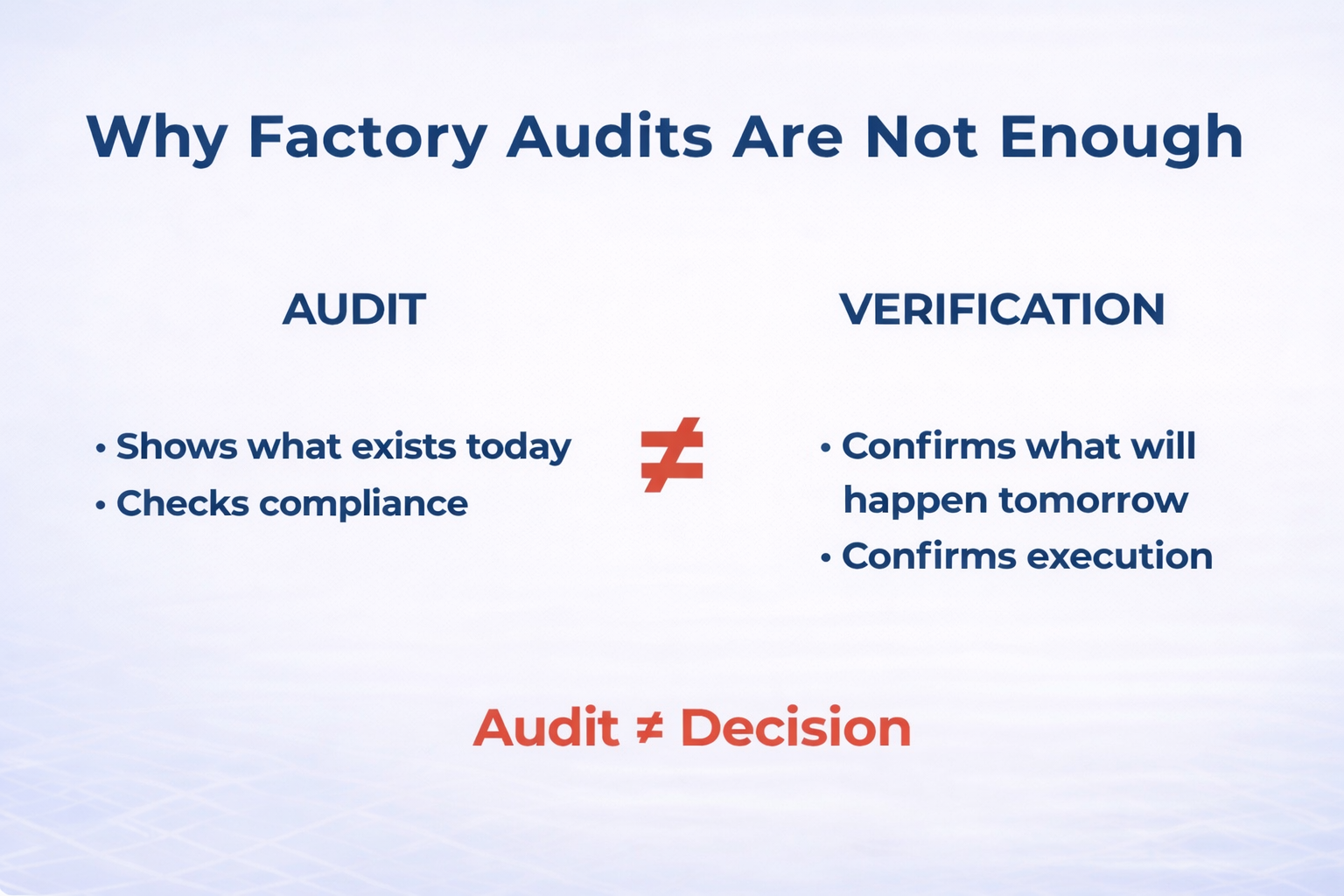
A factory audit shows what exists today. Supplier verification confirms what will happen in execution. Audit ≠ Decision.
A factory audit evaluates visible conditions.
Supplier verification evaluates execution capability.
Audit focuses on compliance.
Verification focuses on control.
Audit supports observation.
Verification supports supplier selection.
A supplier can pass an audit — while execution risk still remains.
This is where supplier verification becomes critical.
Common Mistakes in Supplier Verification
Most companies repeat the same mistakes:
1. Relying on Factory Visits Alone
Seeing is not verification.
2. Confusing Presentation with Capability
A good meeting does not mean execution capability.
3. No Engineering Involvement
Drawings are misinterpreted.
Risks remain unidentified.
4. Ignoring Hidden Outsourcing
Critical processes may not be under direct control.
5. No Clear Supplier Classification
Without a defined GO / CONDITIONAL / NO-GO structure,
supplier selection becomes subjective.
How Supplier Verification Connects to Real Visits
Supplier verification is not separate from factory visits.
It defines how supplier visits should be structured.
A visit without verification becomes:
• observation
• impression
• discussion
A visit with verification becomes:
• structured validation
• engineering alignment
• supplier selection
Real Case: What Happens Without Verification
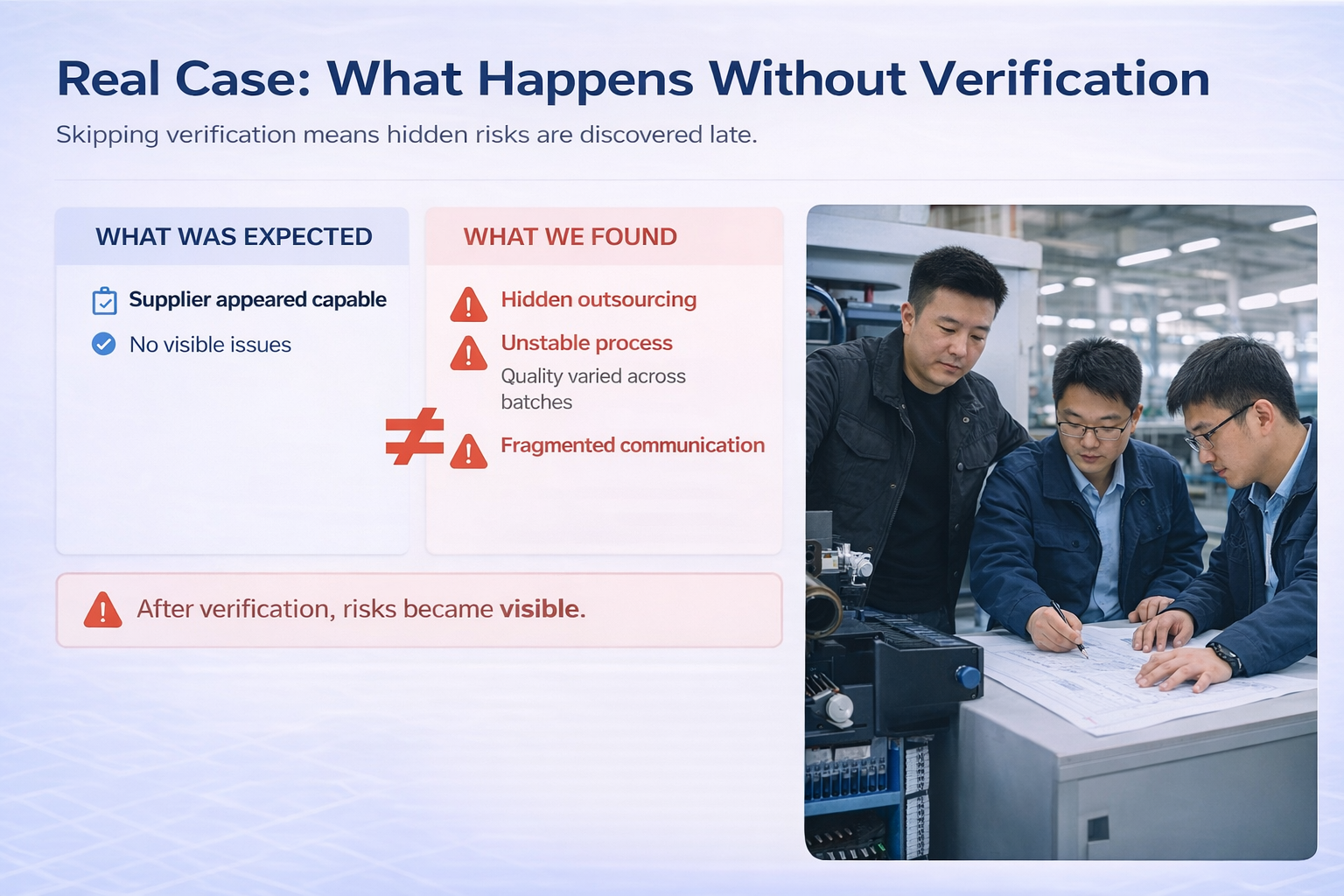
The supplier appeared capable — but the decision was never verified.
In a recent project:
The supplier appeared capable.
But after on-site validation:
• hidden outsourcing was discovered
• process control was unstable
• communication was fragmented
The project had already been delayed for months.
The issue was not production.
It was the original supplier decision.
What You Gain From Proper Verification
When supplier verification is done correctly:
• clear supplier selection
• early risk visibility
• faster decision-making
• more predictable execution
• reduced uncertainty
You move from:
guessing → controlled decision-making
Conclusion
Supplier verification is not a technical step.
It is the foundation of controlled supplier selection.
If verification is weak:
Supplier decisions rely on impressions.
If verification is structured:
Supplier decisions rely on evidence.
That difference affects:
• cost
• timing
• execution stability
• long-term control
Frequently Asked Questions
1. What is supplier verification in China?
It is the process of validating whether a supplier can execute a specific project under real operating conditions.
2. Why does supplier verification fail?
Because companies rely on visits, presentations, and assumptions instead of structured validation.
3. Is a factory audit enough?
No.
A factory audit evaluates visible conditions — not execution capability.
4. When should verification happen?
Before supplier commitment.
5. What is the output of verification?
A defined supplier classification:
• GO
• CONDITIONAL
• NO-GO
Talk to Our Engineers
If you are sourcing in China:
Do not rely on impressions.
Most supplier problems begin long before production starts.
SYY helps European companies:
• structure supplier decisions
• validate real execution capability
• compare suppliers with engineering logic
• reduce hidden execution risk
• turn factory visits into clear decisions
继续阅读
继续查看与当前主题相关的洞察文章。