
China–Europe Supply Chain Delays: Why Manufacturing Projects Drift | SYY Engineering
Many delays in China–Europe manufacturing projects are treated as normal. This article explains where delays really start — from RFQ and prototype to material preparation, trial production, shipping.
Why China–Europe Manufacturing Projects Get Delayed — and Why Many Companies Treat It as “Normal”
Introduction
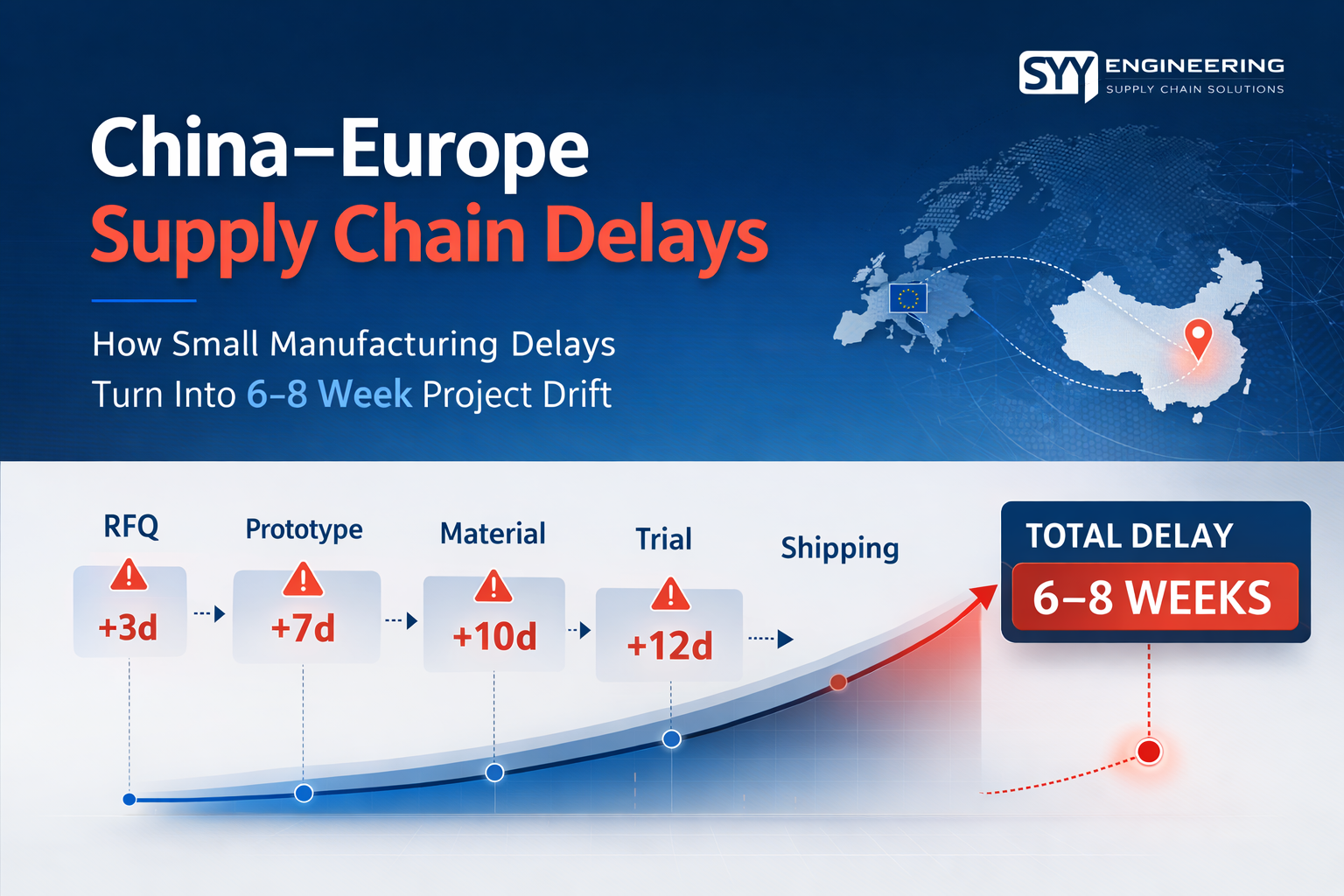
Many delays in China–Europe manufacturing projects are not caused by a single major problem.
In most cases, delays accumulate slowly across different stages of the project.
A few extra days during RFQ may not seem serious.
Another round of samples may feel normal.
Two additional weeks in trial production may be explained as technical adjustment.
However, when these small delays continue to accumulate, the overall project schedule can drift by weeks or even months.
More importantly, many companies gradually begin to treat these delays as “normal”.
And once delays become normal, the real costs — time, resources, and missed opportunities — are rarely questioned.
Why delays are often accepted as normal
In cross-border manufacturing projects, delays rarely happen suddenly.
Instead, they usually appear as small operational issues such as:
• incomplete RFQ information
• technical misunderstandings
• repeated sampling
• supplier coordination gaps
• slow approvals
• logistics disruptions
Because each issue appears small on its own, many teams simply accept them and move forward.
However, when these small delays accumulate across multiple stages, the entire project timeline begins to drift.
Where delays usually begin: RFQ and technical clarification
Many manufacturing delays actually start much earlier than expected.
At the RFQ stage, the biggest risk is not speed but clarity.
If drawings are incomplete, technical requirements are unclear, or responsibilities are not well defined, suppliers may quote based on assumptions.
These uncertainties often remain hidden until the sampling or production stages.
What looks like a fast start may already contain hidden execution risks.
Internal link suggestion:
Supplier Verification in China Manufacturing Projects
Prototype and sampling: when revisions multiply
The prototype stage is often where early misunderstandings become visible.
Common issues include:
• tolerance mismatches
• design modifications
• material substitutions
• failed testing results
• additional validation requirements
Each change can trigger another round of sampling.
While one additional sample may seem manageable, repeated revisions can add several weeks to the project timeline.
Internal link suggestion:
Common Prototype Validation Problems in China Manufacturing
Material preparation: the hidden bottleneck
Material preparation is often the most underestimated stage in project planning.
Even when design and sampling are completed, suppliers may face challenges such as:
• raw material shortages
• delayed purchase order confirmation
• sub-supplier capacity limitations
• batch scheduling conflicts
These problems are less visible than production issues, but they can quietly delay the entire project.
Internal link suggestion:
Supplier Coordination Challenges in China Manufacturing
Trial production: where delays accelerate
Trial production is often the stage where multiple earlier problems converge.
Production parameters may require adjustment.
Processes may still be unstable.
Validation results may not meet expectations.
If earlier technical issues were not fully resolved, they often reappear during trial production.
At this stage, schedule delays become much harder to recover.
Shipping and customs: finished but not delivered
Even after production is completed, delivery delays may still occur.
Typical risks include:
• incorrect documentation
• missed vessel schedules
• customs inspections
• port congestion
• holiday disruptions
These issues often create the impression that logistics caused the delay.
However, in many cases, the root causes appeared much earlier in the project.
Internal link suggestion:
Shipping Delays Between China and Europe: Common Causes
The real cost of small delays
The cost of project delays is rarely limited to production time.
Hidden costs may include:
• extended project management time
• repeated engineering discussions
• additional testing and validation
• misaligned customer expectations
• lost business opportunities
When delays become normalized, these costs are rarely measured accurately.
Why this is not simply a China factory problem
Many people assume delays are caused only by factories.
In reality, delays often result from coordination gaps between project teams.
Typical causes include:
• incomplete technical communication
• slow decision-making
• fragmented project ownership
• unclear approval processes
In cross-border manufacturing projects, communication structure and execution discipline are often more important than production capacity.
How to reduce delay risk earlier
Reducing delays requires addressing problems before production begins.
Key actions include:
• improving technical clarification during RFQ
• defining approval responsibilities early
• aligning communication between teams
• tracking milestones throughout the project
• identifying supplier risks earlier
Projects that invest more effort in early coordination usually experience far fewer delays later.
FAQ
Are delays in China manufacturing always caused by the factory?
No. Many delays result from communication gaps, unclear technical inputs, and coordination challenges between project teams.
Why do small delays become major delays later?
Because delays accumulate across multiple stages of the project.
Which stage is most underestimated?
Material preparation and prototype revisions are often underestimated but can significantly affect the timeline.
How can companies reduce delay risk?
By improving technical clarification, communication structure, and milestone management.
CTA
If your manufacturing project timeline is starting to drift, the issue may have begun much earlier than production.
SYY Engineering helps European companies coordinate suppliers, manage technical communication, and reduce execution risks in China manufacturing projects.
Contact our team to discuss how to reduce delay risks in your next manufacturing project.
Related Articles
• RFQ Mistakes That Cause Manufacturing Delays
• Prototype Validation Risks in China Manufacturing
• Material Preparation Bottlenecks in Supply Chains
• Trial Production Problems in Global Manufacturing
• Shipping Delays Between China and Europe
标签
继续阅读
继续查看与当前主题相关的洞察文章。
Can China’s Zero-Carbon Factory Data Support EU Buyers?
Can China’s zero-carbon factory data support an EU buyer’s import, product, procurement or local-production decision? The answer depends on evidence scope, method, responsibility and validation.
SYY工程框架:从供应商选择到生产落地的中国制造管理方法
在中国管理制造项目,远不只是选择合适的供应商。许多在采购阶段看似顺利的项目,往往会在生产执行和设备落地阶段遇到问题。SYY工程框架通过可视化管理、工程对齐、执行管理和车间整合四个核心支柱,帮助企业系统化管理中国制造项目,提升工程协同效率,降低执行风险,并确保项目从供应商选择顺利过渡到稳定生产。
RAPPORTO DI INSIGHT SULL’INDUSTRIA CINESE DEI TORNI SVIZZERI
L’industria cinese delle 𝗺𝗮𝗰𝗰𝗵𝗶𝗻𝗲 𝗦𝘄𝗶𝘀𝘀-𝗧𝘆𝗽𝗲 𝗖𝗡𝗖 (𝘁𝗼𝗿𝗻𝗶𝗼 𝗦𝘄𝗶𝘀𝘀-𝗧𝘆𝗽𝗲) ha realizzato uno sviluppo 𝗱𝗶𝗿𝗼𝗺𝗽𝗲𝗻𝘁𝗲 𝗻𝗲𝗴𝗹𝗶 𝘂𝗹𝘁𝗶𝗺𝗶 𝗮𝗻𝗻𝗶.