
China Supply Chain Reset: Strategic Opportunities for European SMEs (2025–2030)
China’s manufacturing supply chain is undergoing structural transformation. Discover why 2025–2030 may offer a unique opportunity for European SMEs working with Chinese suppliers.
Introduction
Over the past few years, the global supply chain has undergone profound changes.
Large multinational corporations have reorganized their production networks, diversified sourcing strategies, and moved part of their manufacturing capacity to countries such as Vietnam, India, and Mexico.
At first glance, this trend appears to reduce the role of China in global manufacturing.
However, a deeper look at industrial supply chains tells a different story.
For many European SMEs, the period between 2025 and 2030 may represent one of the most strategic windows to access China’s manufacturing ecosystem.
Understanding this shift is essential for companies that want to remain competitive in the next decade.
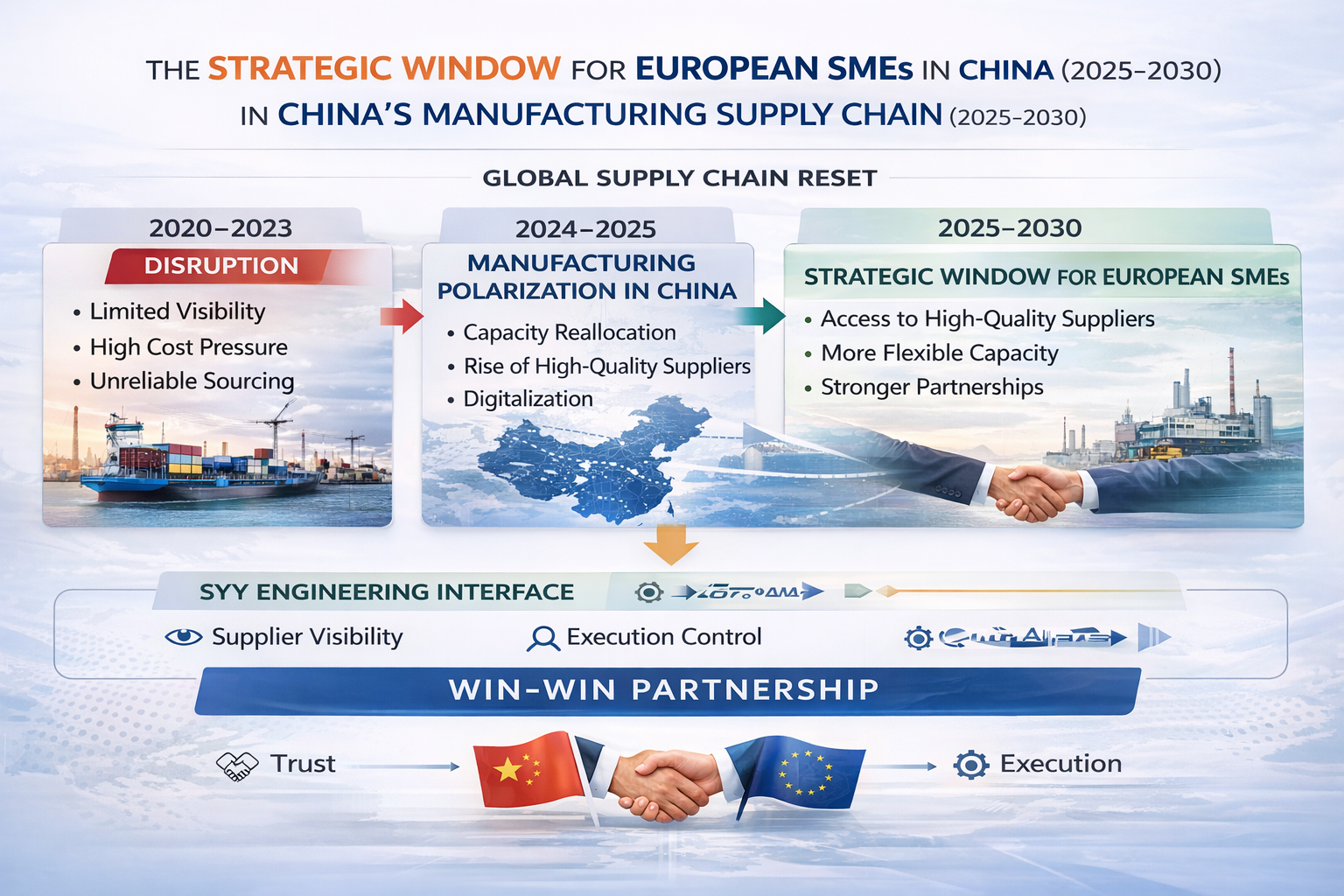
Figure 1 — Strategic Window for European SMEs in China’s Manufacturing Supply Chain (2025–2030)
1 Global Supply Chain Reset
In recent years, many multinational companies have adopted the “China+1” strategy, relocating part of their production capacity outside China.
However, China’s manufacturing ecosystem remains extremely difficult to replicate.
China still offers:
Unmatched industrial clusters
Integrated supplier networks
Rapid engineering response
Highly developed production infrastructure
Because of this shift, an unexpected situation has emerged.
Part of the high-quality manufacturing capacity in China has become available.
Many Chinese suppliers that previously focused only on large multinational corporations are now actively looking for reliable European partners.
For European SMEs, this creates a rare opportunity.
Companies that could not access top-tier suppliers ten years ago may now have a real chance to collaborate with them.
2 Chinese Manufacturing Polarization
Another major transformation taking place in China is industrial polarization.
Weak manufacturers are gradually disappearing from the market, while the strongest suppliers are upgrading rapidly.
Several structural forces are driving this transformation:
Massive investment in industrial automation
Stronger quality management systems
Improved process maturity
Consolidation across manufacturing sectors
China now installs more than half of the world’s industrial robots, reflecting the rapid modernization of its factories.
For European companies, this transformation brings an important benefit.
The supplier landscape is becoming clearer and more transparent.
Instead of navigating thousands of unknown factories, companies can increasingly identify reliable suppliers with mature processes and engineering capabilities.
3 Loss of Supply Chain Visibility
Between 2020 and 2023, many European companies were unable to travel to China.
This period created a serious visibility gap.
Many companies gradually lost real insight into what was happening inside their supply chains.
Common problems include:
Limited visibility into supplier capabilities
Declining performance of long-time suppliers
Difficulty evaluating new partners
Longer and more unpredictable lead times
According to several European industry studies, more than 40% of companies report limited visibility into their key suppliers.
In simple terms:
Many companies today do not fully see, evaluate, or control what happens inside their Chinese supply chains.
And when visibility disappears, risk inevitably increases.
4 Demand and Supply Realignment
The period between 2025 and 2030 is particularly interesting because European demand and Chinese manufacturing capacity are realigning.
On the European side:
Energy costs have increased significantly
Labor costs continue to rise
Small-batch production is becoming more expensive
At the same time, China continues to offer:
Highly developed manufacturing infrastructure
Fast production cycles
Large supplier ecosystems
This creates an unusual alignment.
European companies still need efficient manufacturing capacity, while many Chinese suppliers are actively seeking stable international partners.
Such alignment rarely lasts forever.
5 Why Traditional Sourcing Models No Longer Work
Many SMEs still approach sourcing in China using methods that worked twenty years ago.
Typical approaches include:
One factory visit
Informal supplier relationships
Sample-based decisions
But global supply chains have become far more complex.
Modern sourcing requires a structured engineering-driven approach.
Companies must increasingly focus on:
Technical supplier audits
Hidden subcontracting risk analysis
Process maturity evaluation
Supplier decision-chain mapping
Structured engineering communication
Risk recovery planning
The real challenge is not China itself.
The real challenge is that many companies lack a structured system for managing China-based supply chains.
6 A New Operational Model for SMEs
For many European SMEs, the most effective solution is developing a structured operational model in China.
This can include:
Supplier capability evaluation
Engineering communication with factories
Production monitoring
Quality management systems
Supply chain risk mitigation
Through such a model, companies can rebuild three essential capabilities.
Visibility. Control. Execution speed.
These three elements are critical for managing modern global manufacturing networks.
7 The Strategic Window 2025–2030
Global supply chains move in cycles.
When global demand rises again, high-quality manufacturing capacity will become scarce.
Large multinational companies will return to secure the best suppliers.
When that happens, the current window may close.
The competitive advantage of the next decade may be built between 2025 and 2030.
Companies that position themselves today may gain long-term advantages.
Companies that wait may find that the best opportunities have already disappeared.
Conclusion
China’s manufacturing ecosystem has not disappeared.
It is transforming.
For companies that understand these structural changes and adapt their sourcing strategy accordingly, the coming years may offer significant opportunities.
For companies that continue to rely on outdated sourcing models, risks will continue to grow.
FAQ
Why are many European companies reconsidering China manufacturing?
Many companies are reassessing their sourcing strategies because China still offers unmatched industrial capacity, supplier networks, and manufacturing speed.
Is China still competitive for European SMEs?
Yes. Many Chinese suppliers remain highly competitive in engineering capability, production efficiency, and supply chain integration.
Why is the period 2025–2030 important?
During this period, global supply chains are restructuring while Chinese suppliers still have available production capacity, creating a strategic opportunity.
CTA
If your company is evaluating suppliers in China or reassessing its supply chain strategy, understanding China’s evolving manufacturing ecosystem is essential.
SYY Engineering helps European companies evaluate suppliers, coordinate engineering communication, and manage manufacturing execution across China.
Tags
Continue Reading
Explore related insights on the same topic.
The SYY Engineering Framework | Managing China Manufacturing Projects
Learn how the SYY Engineering Framework helps companies manage China manufacturing projects through engineering visibility, alignment and execution control.
Supplier Verification China: Why Most Supplier Decisions Fail Before Production — and What You’re Missing
Most supplier decisions in China fail before production even starts. Factories look convincing. Projects still fail. Because what you see during a visit is not what you get in execution.
Can China’s Zero-Carbon Factory Data Support EU Buyers?
Can China’s zero-carbon factory data support an EU buyer’s import, product, procurement or local-production decision? The answer depends on evidence scope, method, responsibility and validation.